




Quick answer: Banks are using AI techniques such as anomaly detection, graph networks, and ensemble learning to significantly reduce false positives in fraud detection—cutting them by up to 40% while catching 53% more fraud than traditional rules-based systems. Legacy rule-based approaches flag roughly 15% of transactions, but 72% of those alerts are false positives, creating costly alert fatigue for analysts. AI addresses this by continuously learning normal customer behavior and adapting to new fraud patterns in real time.
As banks deploy increasingly sophisticated AI systems for fraud detection, institutions must simultaneously strengthen their AI regulatory compliance frameworks to ensure these models operate transparently and within evolving legal requirements.
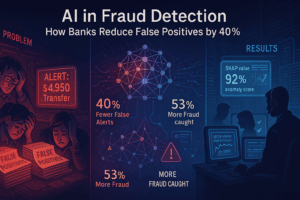
Table of Contents
The $42B Fraud Prevention Challenge
Financial institutions lose $42B annually to payment fraud (Nilson Report, 2024), while simultaneously wasting $3.7B investigating false alarms.
Traditional rules-based systems flag ~15% of transactions for review, but 72% of these alerts are false positives (ACAMS, 2023).
This article reveals how banks like HSBC and BGL BNP Paribas use AI to:
- Cut false positives by 40%
- Detect 53% more fraud (IBM, 2024)
- Reduce investigation time from hours to seconds
1. The Flaws in Traditional Fraud Systems
Problem 1: Rigid Rules Can’t Keep Up
Example: A rule like “Flag transactions >$5,000” misses:
- Small, rapid thefts (“micro-fraud”)
- Behavioral anomalies (e.g., unusual login location)
Result: Only 12% of fraud is caught by rules alone (Javelin, 2024).
“Fraudsters reverse-engineer rules within weeks. One bank found criminals making $4,950 transfers to bypass $5k triggers. Static systems create a false sense of security.”
Institutions implementing advanced anomaly detection and machine learning models increasingly integrate predictive cyber attack intelligence to anticipate and neutralize emerging fraud threats before they impact customer accounts.
Problem 2: Alert Fatigue
Analysts review 300–500 alerts/day—leading to 17% missed fraud due to cognitive overload (Association of Certified Fraud Examiners).
Cost: Each false alert costs $15–$25 in labor (Forrester).
2. How AI Solves This: 3 Advanced Techniques
Technique 1: Anomaly Detection with Unsupervised ML
How it works:
- Models like Isolation Forests and Autoencoders learn normal customer behavior.
- Flags deviations (e.g., sudden $10k transfer from a typically inactive account).
Case Study: BGL BNP Paribas
- Reduced false positives by 40% using Dataiku’s anomaly detection.
- Key feature: “Patient Zero” analysis finds connected fraud patterns.
“Unsupervised models excel at detecting never-before-seen fraud types. But they require at least 6 months of clean historical data to establish baselines.”
Technique 2: Graph Networks for Organized Crime
How it works:
- Maps relationships between accounts, devices, and IPs.
- Uncovers mule networks and layering schemes.
Example: HSBC’s AI System
- Detected a $90M laundering ring via:
- Device fingerprinting
- Transaction timing patterns
- Increased true positives by 35% (HSBC, 2023).
“Graph analytics is revolutionary for AML. But beware—overly dense networks can trigger false links. Set relationship thresholds (e.g., ≥3 shared nodes) to reduce noise.”
Successful fraud detection increasingly depends on balancing accuracy with user experience, raising important questions about ethical AI in finance and how institutions implement these systems responsibly.
Technique 3: Ensemble Learning with Real-Time Feedback
How it works:
- Combines 5–7 models (e.g., Random Forest + Neural Nets).
- Continuously retrains using investigator decisions.
Results at JPMorgan Chase:
- 53% more fraud caught
- 30% faster investigations via automated suspicious activity reports (SARs)
“Ensemble models outperform single algorithms by 15–20% (IEEE, 2024). But they’re computationally expensive—use cloud GPUs for inference.”
3. Implementation Roadmap
Phase 1: Data Preparation (4–6 Weeks)
| Task | Tools | Cost |
|---|---|---|
| Transaction history | Snowflake, BigQuery | $20K–$50K |
| Behavioral biometrics | ThreatMetrix, BioCatch | $100K+/year |
“Prioritize data quality over quantity. One bank wasted $250K on unusable IoT device data.”
Phase 2: Model Development (8–12 Weeks)
- Start simple: Logistic regression baseline
- Add complexity: Graph networks for high-risk segments
- Validate: Use F2-score (balances precision/recall)
AI stress testing validates whether machine learning models maintain detection accuracy under adversarial attacks and evolving fraud patterns before deployment.
Phase 3: Deployment
- Pilot: 5% of transactions
- Shadow mode: Run AI parallel to legacy systems
- Go live: Route only high-confidence alerts to analysts
4. The Future: Explainable AI (XAI) for Compliance
- Regulatory requirement: EU’s AI Act mandates fraud AI be interpretable.
- Solution: SHAP values/LIME show why transactions were flagged.
Example:
“Alert triggered due to:
1. 92% unusual amount for this payee
2. 88% mismatch with user’s typical login time”
Conclusion: Your 90-Day Action Plan
- Audit current systems: What % of alerts are false positives?
- Pick one high-impact area: Start with credit card fraud.
- Build cross-functional team: Fraud ops + data science + compliance.
Frequently Asked Questions
Techniques like anomaly detection and ensemble learning, which are central to modern fraud prevention, also underpin advances in AI in trade finance.
How do banks reduce false positives in fraud detection using AI?
Banks use techniques like unsupervised anomaly detection, graph network analysis, and ensemble learning models that continuously retrain on investigator feedback. These approaches help distinguish genuine fraud from legitimate transactions more accurately than static rules, cutting false positives by up to 40%.
What are the main flaws of traditional rules-based fraud detection systems?
Rules-based systems use rigid thresholds that fraudsters can quickly reverse-engineer, and they miss behavioral anomalies like unusual login locations or micro-fraud. They catch only about 12% of fraud and generate so many alerts that analysts experience cognitive overload, leading to 17% missed fraud cases.
What is ‘Patient Zero’ analysis in AI fraud detection?
‘Patient Zero’ analysis is a feature of anomaly detection platforms, such as the one used by BGL BNP Paribas with Dataiku, that identifies the originating account or entity in a connected fraud pattern and traces how fraud spreads across linked accounts.
How did HSBC use AI to detect money laundering?
HSBC deployed a graph network AI system that mapped relationships between accounts, devices, and IP addresses to uncover mule networks and layering schemes. This approach detected a $90 million laundering ring and increased true positives by 35%.
What does the EU AI Act require for fraud detection AI?
The EU AI Act mandates that AI systems used in fraud detection must be interpretable and explainable to regulators and affected parties. Banks are using tools like SHAP values and LIME to provide clear reasons why specific transactions were flagged.


Recent Comments