



Table of Contents
The Financial Inclusion Imperative: Why AI Matters Now
Despite decades of progress, 1.7 billion adults remain outside the formal financial system (World Bank). Barriers include lack of documentation, distance to bank branches, high transaction costs, and distrust of institutions. AI addresses each barrier: biometric and document verification enables remote onboarding; optimization algorithms route customers to the nearest agent; fraud detection lowers risk and cost; and personalized, voice‑based interfaces build trust.
Three Production‑Scale AI Deployments for Financial Inclusion
These national‑level systems have transformed access to finance for hundreds of millions of people.
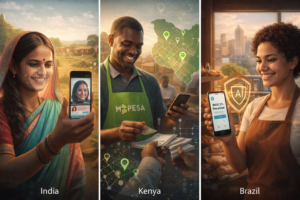
1. India’s Aadhaar: 500 Million Accounts Opened via AI‑Enhanced e‑KYC
Aadhaar, the world’s largest biometric digital identity system, covers 1.4 billion residents. AI powers its face authentication, liveness detection, and fraud prevention. Financial institutions use Aadhaar e‑KYC to onboard customers remotely, eliminating physical document submission.
- AI components: Deep learning for face matching; anti‑spoofing algorithms to detect photo or video replay attacks; anomaly detection for duplicate enrollments.
- Results: 500 million new bank accounts opened using e‑KYC; cost per account dropped from $10 to $0.20; fraud rates below 0.01%.
- Scale: Over 100 billion authentications processed; used by 1,500+ banks and fintechs.
“Aadhaar democratized identity. AI made it secure at scale.”
2. M‑PESA: AI‑Powered Agent Network Serving 30 Million Africans
M‑PESA, the mobile money pioneer, serves 30 million customers across Kenya, Tanzania, and other African markets. Its AI system optimizes the network of 200,000+ agents—local shopkeepers who handle cash‑in, cash‑out, and transfers.
- AI capabilities: Demand forecasting to predict agent liquidity needs; optimal agent placement using geospatial and transaction data; dynamic pricing to incentivize agents in underserved areas.
- Results: 99% of Kenyan adults have access to an agent within 5 km; agent turnover reduced by 25%; financial inclusion reached 89% (up from 26% pre‑M‑PESA).
- Economic impact: Lifted 2% of Kenyan households out of poverty (MIT study).
“AI helps us put an agent exactly where the next customer is waiting—even in the most remote village.”
3. Brazil’s Pix: AI That Protects 40 Billion Instant Payments
Pix, Brazil’s instant payment system, processed over 40 billion transactions in 2025. Its AI‑powered fraud detection system runs in milliseconds, blocking suspicious payments before they complete.
- Detection methods: Graph analytics to identify fraud rings; behavioral biometrics to detect account takeover; real‑time anomaly scoring on each transaction.
- Results: Fraud rates below 0.02% (compared to 0.5% for traditional credit cards); false positive rate under 1%; system handles peak loads of 1,000 transactions per second.
- Adoption: Used by 150 million individuals and 15 million businesses; financial inclusion in Brazil reached 85% (up from 70% pre‑Pix).
“Pix proves that speed and security can coexist. AI watches every transaction, so Brazilians can transact with confidence.”
Comparative Impact: AI‑Driven Inclusion Metrics
The table below summarizes key outcomes from these deployments:
| Country/System | AI Application | Outcome |
|---|---|---|
| India (Aadhaar) | Biometric e‑KYC fraud prevention | 500M new accounts; $0.20 onboarding cost |
| Kenya (M‑PESA) | Agent network optimization | 89% financial inclusion; 2% poverty reduction |
| Brazil (Pix) | Real‑time fraud detection | 85% inclusion; 0.02% fraud rate |
Enabling Technologies for Inclusive AI
These large‑scale deployments rely on a shared technology stack:
- Biometric and document verification: Computer vision and deep learning for face, fingerprint, and document authenticity.
- Graph analytics: Detects fraud rings and optimizes agent networks by analyzing relationships.
- Geospatial machine learning: Maps underserved areas and predicts optimal branch or agent locations.
- Low‑bandwidth AI: Models that run on feature phones or edge devices in areas with poor connectivity.
- Multilingual NLP: Voice‑based interfaces and chatbots in local languages.
Policy and Ethical Considerations for AI‑Driven Inclusion
Deploying AI for financial inclusion requires careful policy design to avoid exclusion or harm.
Key Recommendations
- Data privacy and consent: Explicit, granular consent for biometric and transaction data; right to deletion.
- Algorithmic fairness audits: Regular testing for bias against marginalized groups (women, rural, elderly).
- Redress mechanisms: Human‑in‑the‑loop appeals for AI decisions (e.g., loan denials, fraud blocks).
- Interoperability: Open APIs so multiple providers can build on inclusive infrastructure.
- Digital literacy: AI‑powered tutorials in local languages to help new users navigate financial services.
Implementation Roadmap for Emerging Economies
Governments and development institutions can follow this phased approach:
Phase 1: Digital Identity Foundation (Months 1–18)
- ✔️ Deploy biometric and document‑based identity system with AI fraud prevention.
- ✔️ Pass data protection legislation and establish independent oversight.
- ✔️ Pilot e‑KYC with a small number of financial institutions.
Phase 2: Agent Network & Mobile Money (Months 19–36)
- ✔️ Use geospatial AI to recruit and position agents in underserved areas.
- ✔️ Launch mobile money platform with AI fraud detection.
- ✔️ Offer incentives for last‑mile agents via dynamic pricing algorithms.
Phase 3: Instant Payments & Credit (Months 37–60)
- ✔️ Build real‑time payment rail with AI monitoring for fraud and liquidity.
- ✔️ Deploy alternative credit scoring using transaction and utility payment history.
- ✔️ Enable interoperability between banks, mobile money, and fintechs via open APIs.
Reader Q&A: Financial Inclusion AI Concerns
Q: “Does biometric ID exclude people without documentation or with disabilities?”
A: It can—if not designed inclusively. Aadhaar introduced face authentication for elderly and manual workers whose fingerprints wear. Inclusive design means multiple authentication methods and in‑person enrollment options.
Q: “How do we prevent AI from being used for surveillance or exclusion?”
A: Strong governance is essential. India’s Supreme Court ruled that Aadhaar cannot be made mandatory for private services, protecting citizens from exclusion. Legal frameworks must separate identity verification from surveillance.
Q: “Can AI‑driven inclusion be profitable, or does it require subsidies?”
A: M‑PESA and Pix are commercially sustainable due to transaction volume. AI reduces fraud and operational costs, making low‑margin services viable. However, initial infrastructure (digital ID, payment rails) often requires public investment.
Free Checklist: 5 Signs Your Country Needs AI‑Driven Financial Inclusion
- ☐ More than 30% of adults lack formal bank accounts
- ☐ Documentation requirements exclude rural or informal workers
- ☐ Fraud rates in digital payments exceed 0.5%
- ☐ Bank branches and ATMs are concentrated in urban areas
- ☐ Cross‑border remittances are expensive and slow
The Future: Where Financial Inclusion AI Is Heading
Three frontiers are emerging beyond current deployments:
- Decentralized digital identity (DID): Blockchain‑based self‑sovereign identity that users control, with AI verification for credential issuance.
- AI‑powered micro‑insurance: Parametric insurance for farmers using satellite imagery and weather data, with automatic payouts.
- Cross‑border inclusion: AI that harmonizes KYC across countries, enabling migrant workers to access financial services in destination countries.
“Financial inclusion is not a charity. It is an investment in human potential. AI is the fastest route to universal access.”
Key Takeaways: AI as an Inclusion Engine
- Digital identity is the foundation—AI makes e‑KYC secure and low‑cost.
- Agent networks reach the last mile—geospatial AI optimizes placement and liquidity.
- Real‑time fraud detection enables trust—low fraud rates drive adoption.
- Policy must prioritize privacy, fairness, and redress—technology alone is not enough.


Recent Comments