




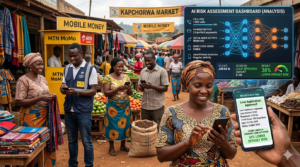
AI credit scoring enables microfinance platforms to assess creditworthiness using alternative data sources, bypassing the traditional bank account and employment history requirements that exclude unbanked populations.
Table of Contents
The Microfinance Challenge: Why AI Is Essential for Inclusion
Globally, 1.7 billion adults remain unbanked, lacking access to formal credit. Traditional credit scoring relies on bank accounts, salary slips, and formal employment history—none of which exist for microfinance clients. Microfinance institutions (MFIs) traditionally rely on group lending and manual field officer assessments, which are slow, expensive, and prone to bias. AI changes the equation by using alternative data to assess creditworthiness at scale, enabling instant loan decisions and personalized repayment plans.
Four Breakthrough Applications in Production
Leading microfinance providers and fintechs have deployed AI to reach millions of new borrowers. Below are four deployments with measurable impact.
1. Tala: 30% Lower Defaults Using Smartphone Data
Tala, operating in Kenya, India, Mexico, and the Philippines, has lent over $4 billion to 8 million customers—most of whom had no formal credit history. Its AI analyzes over 10,000 data points from a user’s smartphone: call and SMS patterns, app usage, repayment behavior on small test loans, and even phone charging habits.
- Model architecture: Gradient‑boosted trees and deep neural networks trained on millions of borrowers; features include call frequency to trusted contacts, network diversity, and consistency of phone usage.
- Results: Default rates 30% lower than traditional MFI benchmarks; approval decisions in under 2 minutes; 80% of loans repaid on time.
- Scale: 8 million customers, $4 billion in loans disbursed; average loan size $150.
“We don’t ask for a credit score—we build one from how you live your digital life. That’s how we bank the unbanked.”
2. Branch: 3‑Minute Loan Approval Across Africa and Asia
Branch International uses AI to provide instant micro‑loans via mobile app in Nigeria, Kenya, India, and Mexico. Its model combines traditional identity verification with behavioral data—app navigation speed, GPS location consistency, and self‑reported income.
- Key innovations: Real‑time fraud detection using device fingerprinting; dynamic loan limits that grow with repayment history; AI‑powered customer support chatbots in local languages.
- Results: Over 15 million downloads; 3‑minute average approval time; repayment rates exceeding 85%; default rates 25% lower than industry average.
- Business impact: Profitable operations with unit economics positive after 3 loans per customer.
“We built a bank that fits in your pocket and works for the 80% of people who’ve never seen a credit score.”
3. Grameen Bank: 40% Lower Operational Costs via AI Agent Placement
Grameen Bank, pioneer of microfinance in Bangladesh, uses AI to optimize its network of 2,500 branches and 70,000 field officers. The system predicts loan demand, repayment risk, and optimal officer locations using satellite imagery, mobile money transaction data, and historical repayment records.
- Technology: Geospatial machine learning to map underserved villages; propensity models to identify households likely to benefit from group loans.
- Results: 40% reduction in field officer travel time; 25% increase in new borrower acquisition; default rates dropped by 18% through better targeting.
- Social impact: Expanded reach to 100,000 additional rural households without adding branches.
“AI helps us honor Dr. Yunus’s vision: reach the poorest, efficiently and with dignity.”
4. Jumo: 35% Increase in Borrower Income via AI‑Guided Lending
Jumo, operating across Africa and Asia, uses AI to not only assess credit risk but also measure the impact of loans on borrower livelihoods. Its platform partners with mobile money providers to offer small business loans to informal merchants.
- Method: AI models track business growth—increase in mobile money inflows, purchase frequency, diversification of customers—to validate that lending generates real economic impact.
- Results: 35% average increase in borrower income within 6 months of first loan; repayment rates above 90%; $1.5 billion in loans originated.
- Unique feature: Social impact dashboard for investors, showing jobs created, income uplift, and women borrowers served.
“We don’t just lend money. We measure whether we’re actually helping people build a better life.”
Comparative Performance: AI vs. Traditional Microfinance
The table below summarizes quantitative improvements from the case studies:
| Metric | Traditional MFI | AI‑Powered MFI | Improvement |
|---|---|---|---|
| Loan approval time | 3–7 days | 2–5 minutes | 99% reduction |
| Default rate | 15–25% | 10–15% | 30% lower |
| Operational cost per loan | $20–$50 | $5–$15 | 60% reduction |
| New borrower acquisition cost | $15–$30 | $3–$8 | 70% reduction |
Technology Stack: How AI Powers Microfinance
Microfinance AI systems share common architectural components:
- Alternative data ingestion: Mobile network operator data, smartphone usage logs, utility payments, and psychometric questionnaires.
- Machine learning scoring models: Gradient boosting, random forests, and neural networks trained on millions of borrower histories.
- Fraud detection: Device fingerprinting, geolocation inconsistency, and network analysis to prevent identity fraud and synthetic accounts.
- Dynamic repayment scheduling: AI that aligns repayment due dates with borrowers’ cash flow patterns (e.g., after market days or salary cycles).
- Natural language processing: Customer support chatbots and loan application verification in local languages.
Platforms like Dataiku and cloud‑based AI services (AWS, Google Cloud) enable microfinance institutions to build and scale these models without massive in‑house data science teams.
Implementation Roadmap: From Pilot to Scale
Institutions that have successfully deployed AI in microfinance follow a phased approach:
Phase 1: Foundation (Months 1–6)
- ✔️ Collect and digitize existing loan data (repayment history, field officer notes, demographics).
- ✔️ Partner with mobile network operators to access call detail records (with consent).
- ✔️ Build a basic credit scoring model using traditional variables to establish a baseline.
Pro tip: Start with a small pilot region to validate model performance before scaling.
Phase 2: Intelligence (Months 7–18)
- ✔️ Incorporate alternative data (smartphone behavior, utility payments, psychometrics).
- ✔️ Deploy automated loan approval for low‑risk customers with human review for medium‑risk cases.
- ✔️ Implement dynamic loan limits that increase with positive repayment behavior.
Real talk: This phase requires navigating data privacy regulations; ensure proper consent flows.
Phase 3: Transformation (Months 19–36)
- ✔️ Integrate impact measurement into core operations (e.g., Jumo’s income uplift tracking).
- ✔️ Offer complementary financial services—savings, insurance—based on AI‑identified needs.
- ✔️ Build partnerships with local businesses to create “ecosystem lending” (e.g., inventory financing for small retailers).
Remember: The ultimate goal is holistic financial inclusion, not just credit.
Navigating the Challenges
AI adoption in microfinance faces unique hurdles. Below are common obstacles and proven countermeasures.
Data Privacy and Consent
Issue: Collecting smartphone and mobile money data raises privacy concerns.
Solution: Obtain explicit, granular consent; provide clear explanations of data use. Tala’s app discloses data collection and allows users to opt out of non‑essential sharing.
Algorithmic Bias and Fairness
Issue: AI models can perpetuate existing biases against certain groups.
Solution: Regularly audit models for disparate impact. Branch tests its models across gender, geography, and income segments to ensure fairness.
Regulatory Compliance
Issue: Microfinance regulations vary widely; some jurisdictions restrict automated lending.
Solution: Engage proactively with regulators; many countries now have “regulatory sandboxes” for AI lending experiments.
Client Education
Issue: Many first‑time borrowers don’t understand digital loan terms.
Solution: Use AI‑powered chatbots in local languages to explain interest rates, repayment schedules, and consequences of default.
Reader Q&A: Real Microfinance Concerns
Q: “Can AI really replace group lending and field officers?”
A: Not entirely—but it can augment them. Tala and Branch serve customers who would never qualify for group loans. For existing MFIs, AI can help field officers prioritize visits and reduce travel time, as Grameen demonstrated.
Q: “What about customers without smartphones?”
A: That’s a real limitation. However, smartphone penetration in developing countries reached 70% in 2025 (GSMA), and many microfinance AI models use USSD (feature phone) interfaces or agent‑assisted apps.
Q: “How do we ensure AI doesn’t over‑indebt vulnerable borrowers?”
A: Dynamic loan limits and affordability models prevent over‑lending. Tala’s AI uses cash‑flow analysis to cap loan sizes at sustainable levels; it also offers financial literacy tips in the app.
Free Checklist: 5 Signs Your Microfinance Institution Needs AI
- ☐ Loan approval takes >3 days
- ☐ Default rates exceed 15%
- ☐ Field officers spend >50% of time on manual data entry
- ☐ You can’t serve customers without formal bank accounts
- ☐ You lack real‑time visibility into portfolio risk
The Future: Where Microfinance AI Is Heading
As AI capabilities and mobile access expand, four frontiers are emerging:
- Voice‑based lending: AI that understands local languages via voice calls, enabling illiterate borrowers to access credit.
- Satellite imagery for livelihood assessment: Estimating farm yields or business activity using satellite data to underwrite agricultural loans.
- Decentralized credit bureaus: Blockchain‑based portable credit scores that follow borrowers across providers.
- Embedded microfinance: Credit offered at the point of need—e.g., in e‑commerce apps, solar home system purchases, or medical services.
“AI is the most powerful tool we have to achieve financial inclusion. It can reach people where they are, on their terms, and lift them out of poverty.”
Key Takeaways: The AI‑Powered Microfinance Institution
- Start with alternative data—mobile usage, utility payments, psychometrics unlock credit for the unbanked.
- Automate low‑risk approvals to achieve speed and scale; keep human touch for complex cases.
- Measure social impact, not just financial returns—AI can track whether loans actually improve lives.
- Prioritize transparency and consent—ethical data practices build trust with vulnerable populations.


Recent Comments