


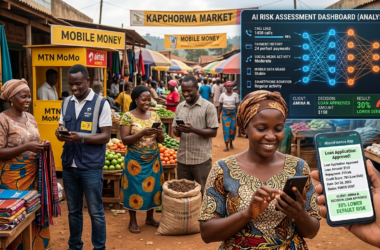
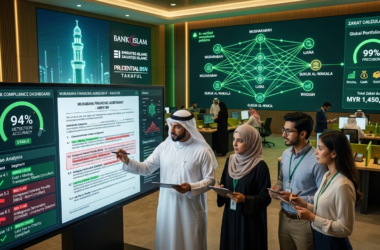

AI fraud detection systems analyze transaction patterns and document authenticity across trade finance networks to identify suspicious activities that human reviewers might overlook.
Table of Contents
The $8 Trillion Paper Trail: Why Trade Finance Begs for AI
Global trade finance handles over $8 trillion annually, yet its core processes remain stubbornly manual. A single letter of credit (LC) transaction can involve 20+ parties, 50+ documents, and weeks of processing time. The costs are enormous: manual document review accounts for 30–40% of operational expenses, and trade‑based money laundering accounts for an estimated $1.6 trillion in illicit flows annually (UNODC).
Traditional trade finance relies on physical documents—bills of lading, invoices, packing lists, certificates of origin—shuffled by courier, fax, or email. Fraudsters exploit this opacity: duplicate invoices, fake shipping documents, and shell companies proliferate. AI offers a path out of this analog morass.
Four Breakthrough Applications in Production
Leading financial institutions and fintechs have moved from pilot to scale. Below are four deployments that demonstrate measurable ROI.
1. Standard Chartered: 70% Faster Document Processing
Standard Chartered processes over $100 billion in trade transactions annually. Its AI platform, launched in 2024, uses optical character recognition (OCR) and natural language processing to ingest unstructured documents—bills of lading, invoices, insurance certificates—and extract structured data fields such as consignee name, vessel number, value, and shipping date.
- Implementation: A multi‑model pipeline: OCR → entity extraction → validation against letter of credit terms → discrepancy flagging.
- Result: Document processing time reduced by 70%, from an average of 3 days to 6 hours. Discrepancy detection improved by 45%.
- Human impact: Trade operations staff shifted from manual data entry to exception handling and client advisory roles.
“We’ve turned days into hours. Our clients now get real‑time visibility into their trade flows, and our teams focus on value‑added work.”
2. HSBC: 94% Accuracy in Letter of Credit Fraud Detection
HSBC’s trade finance AI targets a specific fraud vector: duplicate financing where the same underlying goods are financed through multiple banks using counterfeit documents. The system employs graph analytics to map relationships between importers, exporters, shipping lines, and document numbers across thousands of transactions.
- Detection method: Graph neural networks identify clusters of high‑risk entities; anomaly detection flags duplicate invoice numbers or identical shipping container IDs appearing in separate LCs.
- Outcome: In 2025, the system detected a $45 million fraud ring operating across Hong Kong, Singapore, and UAE that had evaded traditional rule‑based checks for 18 months.
- Metrics: 94% fraud detection rate (up from 68% with rules‑based systems); 60% reduction in false positives, saving analyst time.
“The AI doesn’t just flag suspicious transactions—it connects dots that human investigators would never have time to find.”
3. DBS Bank: Supply Chain Finance Approval Cut from Days to Hours
DBS Bank’s supply chain finance (SCF) business serves thousands of SME suppliers across Asia. Traditionally, each supplier’s eligibility was assessed manually based on buyer relationships and credit checks—a process that took 5–7 days. DBS deployed a machine learning model that scores suppliers on real‑time data: transaction history, payment behavior, and even news sentiment about the buyer.
- Model inputs: 200+ features, including invoice aging patterns, buyer payment reliability, and external credit bureau data.
- Results: Approval time reduced from days to hours; 35% increase in approved suppliers; non‑performing loan rates unchanged.
- Business impact: DBS captured 22% market share in Asian SCF within two years.
“We democratized supply chain finance. Now a small manufacturer in Vietnam gets the same fast, transparent approval as a multinational.”
4. Ant Group: AI-Powered Trade Document Intelligence Platform
Ant Group’s Trusple platform, built on blockchain and AI, automates the entire trade document lifecycle for small businesses. Sellers upload invoices and shipping documents; the AI verifies authenticity against customs data, logistics records, and buyer payment history.
- Capabilities: Computer vision for document tampering detection; NLP for cross‑document consistency checks; integration with 12 customs authorities.
- Metrics: 96% of documents processed without human review; dispute resolution time reduced from 15 days to 3 days.
- Scale: Processed $3 billion in trade volume in 2025, with 50,000 SMEs.
“We’ve removed the trust barrier in cross‑border trade. AI and blockchain together make the paper trail tamper‑proof and instant.”
Comparative Performance: AI vs. Traditional Trade Finance
The table below summarizes quantitative improvements from the case studies:
| Metric | Traditional Process | AI‑Powered Process | Improvement |
|---|---|---|---|
| Document processing time | 3 days | 6 hours | 70% reduction |
| Fraud detection rate | 68% | 94% | +26 percentage points |
| False positive rate | 40% | 16% | 60% reduction |
| SCF approval time | 5–7 days | 2–4 hours | 95% reduction |
Technology Stack: How AI Powers Trade Finance
Trade finance AI relies on a layered architecture. The following components are common across production deployments:
- Optical Character Recognition (OCR): Extracts text from scanned documents and PDFs.
- Natural Language Processing (NLP): Identifies entities (parties, amounts, dates) and matches them against LC terms.
- Computer Vision: Detects tampering, watermarks, and signature discrepancies.
- Graph Analytics: Maps relationships between importers, exporters, shipping lines, and document references to detect fraud rings.
- Blockchain (optional): Provides immutable audit trail; Ant Group combines AI with blockchain for document authenticity.
Platforms like Dataiku and IBM TradeLens provide the orchestration layer, allowing trade finance teams to build, deploy, and monitor models without deep coding expertise.
Implementation Roadmap: From Pilot to Scale
Banks that have successfully deployed AI in trade finance follow a phased approach:
Phase 1: Digitization (Months 1–6)
- ✔️ Centralize trade documents in a structured data lake.
- ✔️ Implement OCR and basic NLP to extract key fields.
- ✔️ Build a dashboard for operations teams to view processing metrics.
Pro tip: Start with one document type—bills of lading are often the highest volume.
Phase 2: Intelligence (Months 7–18)
- ✔️ Train machine learning models for discrepancy detection and fraud scoring.
- ✔️ Integrate with external data sources: shipping lines, customs, credit bureaus.
- ✔️ Automate low‑risk straight‑through processing (STP) with human‑in‑the‑loop for exceptions.
Real talk: This phase requires collaboration between trade operations, data scientists, and compliance teams.
Phase 3: Transformation (Months 19–36)
- ✔️ Deploy graph analytics for fraud ring detection.
- ✔️ Offer API‑based services to corporate clients for self‑service trade finance.
- ✔️ Embed AI into supply chain finance, dynamic discounting, and receivable financing.
Remember: The end state is a fully digitized, predictive trade finance operation.
Navigating the Challenges
AI adoption in trade finance faces specific hurdles. Below are common obstacles and proven countermeasures.
Data Fragmentation and Quality
Issue: Trade documents come in dozens of formats, languages, and quality levels.
Solution: Invest in a document ingestion layer that normalizes inputs. Standard Chartered built a pipeline that supports 25+ languages and 200+ document templates.
Regulatory and Jurisdictional Complexity
Issue: Trade finance involves multiple jurisdictions with conflicting data privacy laws.
Solution: Use federated learning or on‑premise AI where data cannot leave certain regions. Ant Group’s platform processes documents locally within each country’s data boundary.
Interoperability with Legacy Systems
Issue: Core banking systems are often mainframe‑based.
Solution: Build middleware APIs that translate AI outputs into formats existing systems can consume. HSBC’s fraud detection system runs in a separate cloud environment but pushes alerts via secure API to the core transaction system.
Reader Q&A: Real Trade Finance Concerns
Q: “Can AI fully automate trade finance, or will human oversight always be required?”
A: High‑value or complex transactions will always need human judgment, but 70–80% of routine trade finance transactions can be automated. The hybrid model—AI processes, humans handle exceptions and relationships—is the industry standard.
Q: “What about smaller banks or corporates with limited budgets?”
A: Cloud‑based AI services (e.g., AWS Trade Finance AI, IBM TradeLens) offer pay‑as‑you‑go models. Many regional banks start with a single use case—like invoice fraud detection—and scale from there.
Q: “How do we ensure AI doesn’t create new compliance risks (e.g., biased decisions)?”
A: Use explainable AI techniques and maintain human review loops. HSBC’s fraud detection system provides a “reason code” for every flag, which is reviewed by a compliance officer before any action is taken.
Free Checklist: 5 Signs Your Trade Finance Operations Need AI
- ☐ Document processing takes >48 hours per transaction
- ☐ Your fraud detection rate is below 80%
- ☐ You’ve experienced at least one trade‑based money laundering incident in the past 3 years
- ☐ Supply chain finance approvals take >3 days
- ☐ Your operations team spends >50% of time on manual data entry
The Future: Where Trade Finance AI Is Heading
As AI models and data sharing mature, three frontiers are emerging:
- Autonomous trade execution: AI systems that negotiate, execute, and settle trade contracts without human intervention.
- Predictive supply chain finance: AI that forecasts a supplier’s working capital needs and offers pre‑approved financing before the supplier asks.
- Cross‑border data consortia: Shared, permissioned AI models that operate across multiple banks to detect systemic fraud while preserving privacy.
“The future of trade finance is invisible—AI will run in the background, making cross‑border commerce as seamless as domestic payments.”
Key Takeaways: The AI‑Powered Trade Finance Institution
- Document automation is the entry point—start with OCR and NLP for high‑volume documents.
- Fraud detection delivers highest ROI—graph analytics can expose hidden networks that manual reviews miss.
- Integration with core systems is critical—AI outputs must reach operations teams in their existing workflow.
- Hybrid human‑AI models are the standard—AI handles routine processing; humans manage exceptions and relationships.


Recent Comments