


Last updated: November 25, 2026
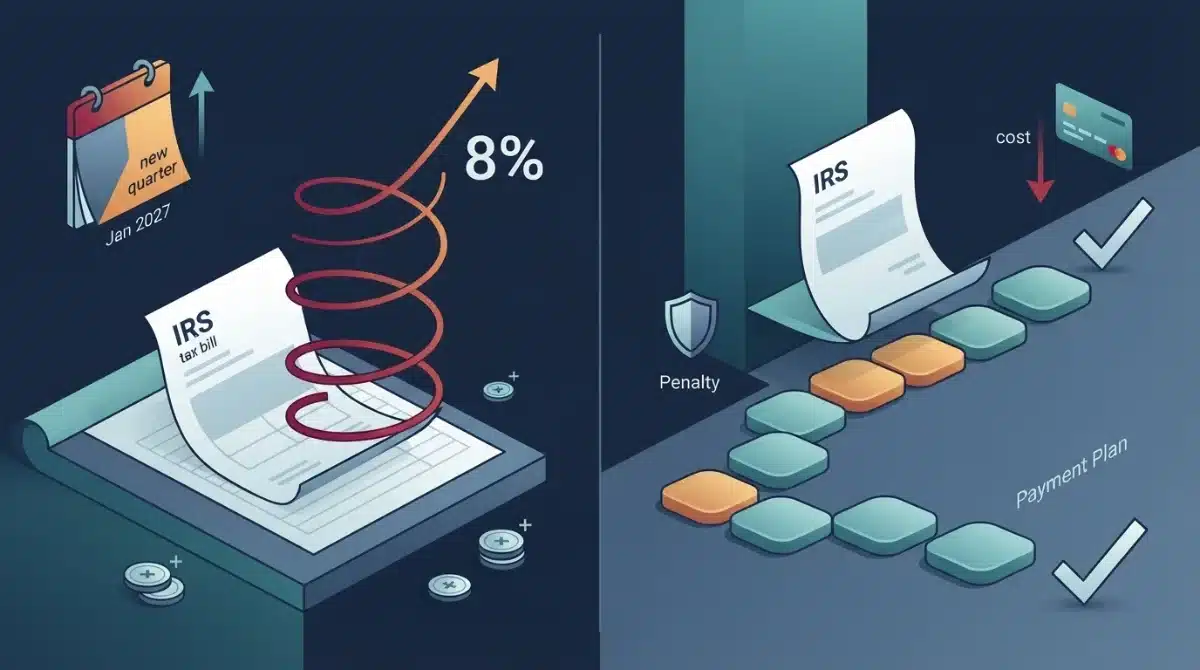
The IRS will charge individuals 8% a year on unpaid tax from January 1, 2027, up from 7% in the final quarter of 2026. The agency announced the change on November 24 in news release IR-2026-144.
If you already owe the IRS, or expect to owe when you file in 2027, this is the rate that grows your balance every day until it is paid. Here is what it adds to a typical payment plan, and what you can do about it.
Table of Contents
The new IRS interest rates at a glance
| Rate | Q4 2026 (Oct–Dec) | Q1 2027 (Jan–Mar) |
|---|---|---|
| Underpayments (tax you owe) | 7% | 8% |
| Overpayments to individuals (refund interest) | 7% | 8% |
| Corporate overpayments | 6% | 7% |
| Large corporate underpayments | 9% | 10% |
The rate for individuals is the federal short-term rate plus 3 percentage points, and it is compounded daily. The IRS resets it every quarter, so the 8% figure is confirmed for January to March 2027 only.
For context, the rate was 8% throughout 2024, then 7% for all of 2025. In 2026 it was 7%, 6%, 7% and 7%.
Why does my IRS balance keep going up on a payment plan?
Because a payment plan does not freeze your balance. The IRS says interest and some penalties “continue to be added to the amount you owe until the balance is paid in full”.
Two charges run side by side:
- Interest at the quarterly rate (8% from January), compounded daily, on the tax, penalties and interest you still owe.
- The failure-to-pay penalty, normally 0.5% of the unpaid tax for each month or part month. If you filed on time and have an approved payment plan, the IRS cuts this to 0.25% a month while the plan runs. The penalty is capped at 25% of the unpaid tax.
The IRS also charges interest on penalties.
How much interest will the IRS charge on my payment plan in 2027?
We modeled a balance paid off in equal monthly installments starting in January 2027. The figures assume the 8% rate holds for the whole plan, a 0.25% monthly failure-to-pay penalty, and that the whole balance is tax. They are estimates to show the scale, not what your IRS notice will say.
| Tax owed | Plan length | Monthly payment | Interest + penalty at 8% | Same plan at 7% |
|---|---|---|---|---|
| $5,000 | 12 months | $442 | $298 | $271 |
| $5,000 | 24 months | $232 | $574 | $520 |
| $10,000 | 12 months | $883 | $596 | $541 |
| $10,000 | 24 months | $464 | $1,148 | $1,040 |
| $25,000 | 24 months | $1,161 | $2,870 | $2,599 |
On a $10,000 balance paid over two years, the one-point rise adds about $108. The bigger lesson is the total: roughly $1,150 in interest and penalty, before any setup fee.
What does it cost to set up an IRS payment plan?
The IRS payment plans page lists these setup fees for individuals:
| Plan type | Apply online | Apply by phone, mail or in person |
|---|---|---|
| Short-term plan (180 days or less) | $0 | $0 |
| Long-term plan with direct debit | $29 | $107 |
| Long-term plan, other payment methods | $69 | $178 |
| Low-income taxpayers | Direct debit fee waived; otherwise $43, which may be reimbursed | |
Individuals can apply online for a long-term plan if they owe $50,000 or less in combined tax, penalties and interest and have filed all required returns. Short-term plans are open online to those owing less than $100,000.
How can I cut what I pay?
- File on time, even if you can’t pay. The failure-to-file penalty is far bigger than the failure-to-pay penalty, and filing on time is what qualifies you for the reduced 0.25% rate on a plan.
- Use the shortest plan you can afford. A 12-month plan on $10,000 costs about half the interest of a 24-month plan in our model.
- Apply online and choose direct debit. It is the cheapest setup fee ($29) and avoids missed payments.
- Pay what you can now. Every dollar paid before January 1 stops accruing at 8%.
- Ask about penalty relief. The IRS can remove some penalties if you can show reasonable cause. By law, it cannot remove interest unless the related penalty is removed.
- Don’t ignore a levy notice. If you don’t pay within 10 days of a notice of intent to levy, the failure-to-pay penalty rises to 1% a month.
What if the IRS owes me money?
The rise works in your favor too. Individuals due an overpayment, such as a refund paid late, earn 8% a year from January 1, 2027, up from 7%. The IRS sets that rate the same way, at the federal short-term rate plus 3 points.
Will the rate stay at 8% all year?
Nobody can say. The rate is reset each quarter from the federal short-term rate set in the first month of the previous quarter. The January figure comes from October 2026, as Revenue Ruling 2026-25 explains. If short-term rates fall, the April 2027 rate could drop back. Check the IRS quarterly interest rates page each quarter.
FAQ
What is the IRS interest rate for January 2027?
8% a year for individual underpayments and overpayments, compounded daily, for January 1 to March 31, 2027.
How much interest does the IRS charge on a payment plan?
The quarterly rate (8% from January 2027) on what you still owe, plus a failure-to-pay penalty of 0.25% a month if you filed on time and have an approved plan.
Can I avoid interest by setting up a payment plan?
No. Interest keeps running until the balance is paid in full. A plan reduces the monthly penalty, not the interest.
Is a short-term payment plan free?
It has no setup fee, but interest and penalties still apply until the balance is paid.
Why did the IRS raise its interest rate?
The rate follows a formula: the federal short-term rate plus 3 points. The IRS says the new rate was computed from the federal short-term rate set in October 2026.
Related reading
- New 401(k) Automatic Enrollment Rules: What Workers Need to Know Before 2028
- Backward Hat Capital Charged in Alleged $600 Million Ponzi Scheme: What Investors Can Do Now
- Chase Credit Card 0% Offer Ending? Why Interest Can Start the Same Day
Sources: IRS news release IR-2026-144 (November 24, 2026) and Revenue Ruling 2026-25; IRS quarterly interest rates; IRS payment plans and installment agreements; IRS failure to pay penalty. Worked examples calculated by The Fintech Mag. This article is general information, not tax advice.


Recent Comments