


Last updated: November 24, 2026
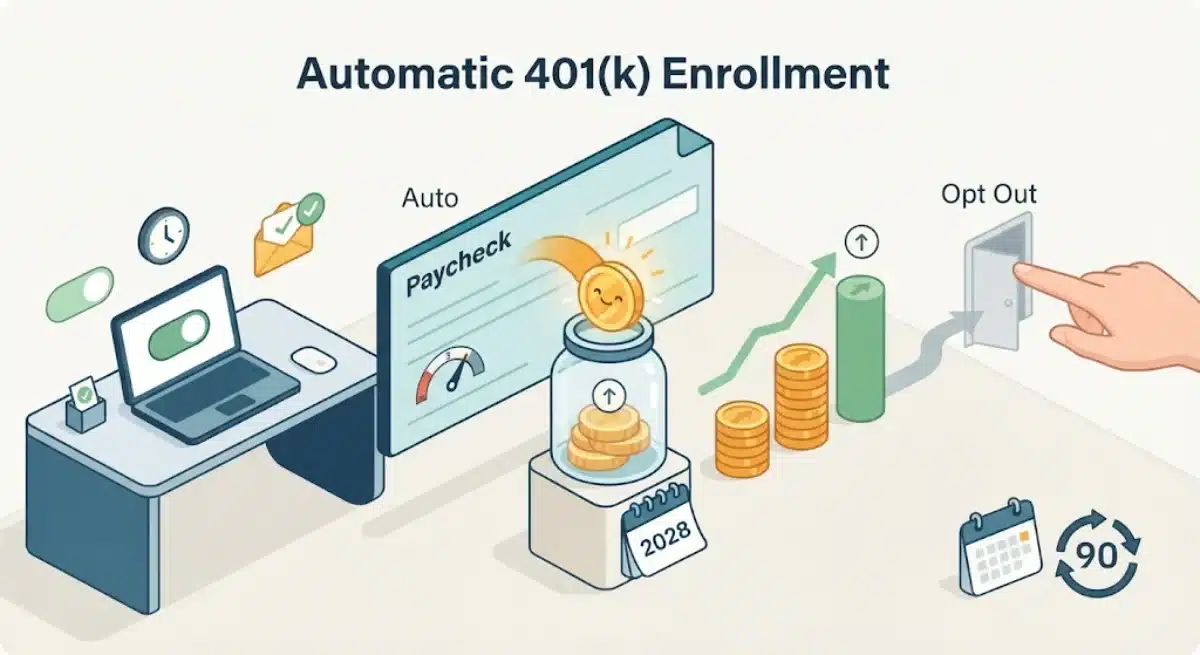
Your employer may soon sign you up for its 401(k) without asking. On November 17, 2026, the Treasury Department and the IRS issued final rules on SECURE 2.0’s automatic enrollment requirement. They tell employers exactly how it works, and they generally apply to plan years beginning after December 31, 2027.
Most coverage so far has been written for employers and plan administrators. This guide is for the worker on the other end: will it apply to you, how much comes out of your paycheck, and how to say no or get the money back.
Table of Contents
What did the IRS just finalize?
The IRS announcement covers section 414A of the tax code, added by the SECURE 2.0 Act of 2022. It requires certain new 401(k) and 403(b) plans to enroll eligible employees automatically.
The final regulations were published in the Federal Register on November 18, 2026. Two dates matter:
| Date | What happens |
|---|---|
| January 19, 2027 | The regulations take effect |
| Plan years beginning after December 31, 2027 | The rules generally start to apply (so January 1, 2028 for a calendar-year plan) |
Treasury estimates the automatic enrollment provision will raise retirement savings by an average of $4.2 billion a year over 2023 to 2032.
Will I be automatically enrolled in my 401(k)?
Only if your plan is covered. The law exempts a long list of plans, and the biggest exemption is age: plans set up before December 29, 2022, the day SECURE 2.0 became law, are not required to auto-enroll.
The Federal Register notice lists these exceptions:
| Plan type | Required to auto-enroll? |
|---|---|
| 401(k) plan set up on or after December 29, 2022 | Yes, unless another exception applies |
| 401(k) plan set up before December 29, 2022 | No |
| 403(b) plan set up before December 29, 2022 | No |
| SIMPLE 401(k) | No |
| Government plans | No |
| Church plans | No |
| Business in existence for less than 3 years | No, until it passes 3 years |
| Business that normally employs 10 or fewer employees | No, until about a year after it normally employs more than 10 |
So if you work for a large company with a long-running 401(k), nothing may change. If you join a newer company, or your employer launched its plan after 2022, expect a contribution to start on your first paychecks unless you act.
Employers can still choose auto-enrollment voluntarily, so the quickest way to know is to ask HR or read your plan’s enrollment notice.
How much will come out of my paycheck?
The IRS says covered plans generally must:
- start you at a 3% contribution rate of pay
- raise it by at least 1 percentage point a year after the first participation period
- keep going until you reach at least 10%, with a maximum of 15%
Here is how that looks on a $60,000 salary, assuming the minimum 1-point steps and no pay raise (an illustration, not a forecast):
| Year | Default rate | Yearly contribution on $60,000 | Per paycheck (26 a year) |
|---|---|---|---|
| 1 | 3% | $1,800 | $69.23 |
| 2 | 4% | $2,400 | $92.31 |
| 3 | 5% | $3,000 | $115.38 |
| 5 | 7% | $4,200 | $161.54 |
| 8 | 10% | $6,000 | $230.77 |
Contributions are pre-tax for a traditional 401(k), so your take-home pay falls by less than the contribution itself. Your actual figures depend on your plan, your pay and any employer match.
The ceiling for your own contributions also rose for 2027. The IRS says the 401(k) limit increases to $25,500 for 2027, up from $24,500 for 2026.
Can I opt out of automatic 401(k) enrollment?
Yes. The IRS is clear that employees may opt out or choose a different contribution rate. You can also stop the automatic yearly increases by picking your own fixed rate.
Your employer has to send you a notice before the default contributions begin. The regulations require that the default start no earlier than a reasonable period after you receive that notice, so you have time to decide.
I didn’t opt out in time. Can I get my money back?
Often, yes. Plans set up under these rules must be “eligible automatic contribution arrangements.” Under the tax code section the regulations rely on, those plans may let you withdraw your default contributions, plus earnings, if you ask within 90 days of the first automatic contribution.
Check your plan’s notice for the exact window and how to request it. Miss the 90 days and the money normally stays in the plan under the usual withdrawal rules.
Where does my money go if I don’t choose?
If you are enrolled and pick nothing, the law says your contributions must go into a “qualified default investment alternative” under Labor Department rules. In practice that is often a target-date fund based on your expected retirement year.
You can switch to other investments in the plan at any time the plan allows. Before you leave money in a default fund for years, check its fees in your plan’s fee disclosure.
Should I stay enrolled?
That depends on your situation, and this is not personal advice. A few questions to ask yourself:
- Is there an employer match? If your employer matches contributions, opting out usually means leaving part of your pay package unclaimed. Our Lendtable review looks at one company built around capturing that match.
- Do you have high-interest debt or no emergency savings? Some people choose a lower rate for a while instead of opting out entirely.
- Is 3% enough? The default is a floor, not a target. You can set a higher rate from day one.
Whatever you choose, an automatic 401(k) is still an investment. Our report on the Backward Hat Capital charges is a reminder to stick to regulated plans and check anyone offering returns that sound too good.
401(k) automatic enrollment: key facts
| Item | Detail |
|---|---|
| Rule | Tax code section 414A, added by SECURE 2.0 (2022) |
| Final regulations | Issued November 17, 2026; published November 18, 2026 |
| Effective date | January 19, 2027 |
| Applies to | Plan years beginning after December 31, 2027 |
| Default rate | 3%, rising at least 1 point a year to at least 10%, max 15% |
| Opt out | Yes, or choose a different rate |
| Refund window | Plans may allow withdrawal of default contributions requested within 90 days |
| Main exemptions | Plans set up before December 29, 2022; businesses under 3 years old or with 10 or fewer employees; SIMPLE 401(k), government and church plans |
Readers outside the US may know a similar idea: UK employers have their own automatic enrollment system for workplace pensions. Our piece on the UK workplace pension charge cap shows how a different country handles fees on default funds.
FAQ
When do the new 401(k) automatic enrollment rules start?
The final regulations take effect on January 19, 2027, and generally apply to plan years that begin after December 31, 2027.
Why did my job automatically enroll me in a 401(k)?
Some employers already use automatic enrollment by choice. From 2028, many plans set up on or after December 29, 2022 must do it under SECURE 2.0.
Is it legal for my employer to automatically enroll me in a 401(k)?
Yes. Federal law allows it, and for covered plans it will be required. You keep the right to opt out or change your rate.
How do I opt out of automatic 401(k) enrollment?
Follow the instructions in your plan’s automatic enrollment notice, usually through your plan’s website or HR. Choose a 0% rate or a different rate before the first deduction.
Can I get back money that was automatically taken for my 401(k)?
Many automatic enrollment plans allow a withdrawal of the default contributions, plus earnings, if you ask within 90 days of the first one. Check your plan’s notice.
Does automatic enrollment apply to small businesses?
Not to businesses that have existed for less than three years or that normally employ 10 or fewer employees, under the exceptions listed in the final regulations.
Sources: IRS: Treasury, IRS issue final rules (IR-2026-141, November 17, 2026); Federal Register: Automatic Enrollment Requirements Under Section 414A (November 18, 2026); IRS newsroom: 401(k) limit increases to $25,500 for 2027 (IR-2026-136, November 12, 2026). Read November 24, 2026.
This article is general information, not financial, tax or legal advice.


Recent Comments