




Last updated: 12 November 2026
The government has added one more change to its plans to widen credit union membership in Great Britain. Announced by HM Treasury on 11 November 2026, it would let a member who moves out of a credit union’s area still refer a relative or someone in their household to join.
HM Treasury says more than 50,000 people who cannot refer family today would be able to, citing Bank of England data. The change was announced at the second reading of the Financial Services and Markets Bill, which is now going through the House of Commons.
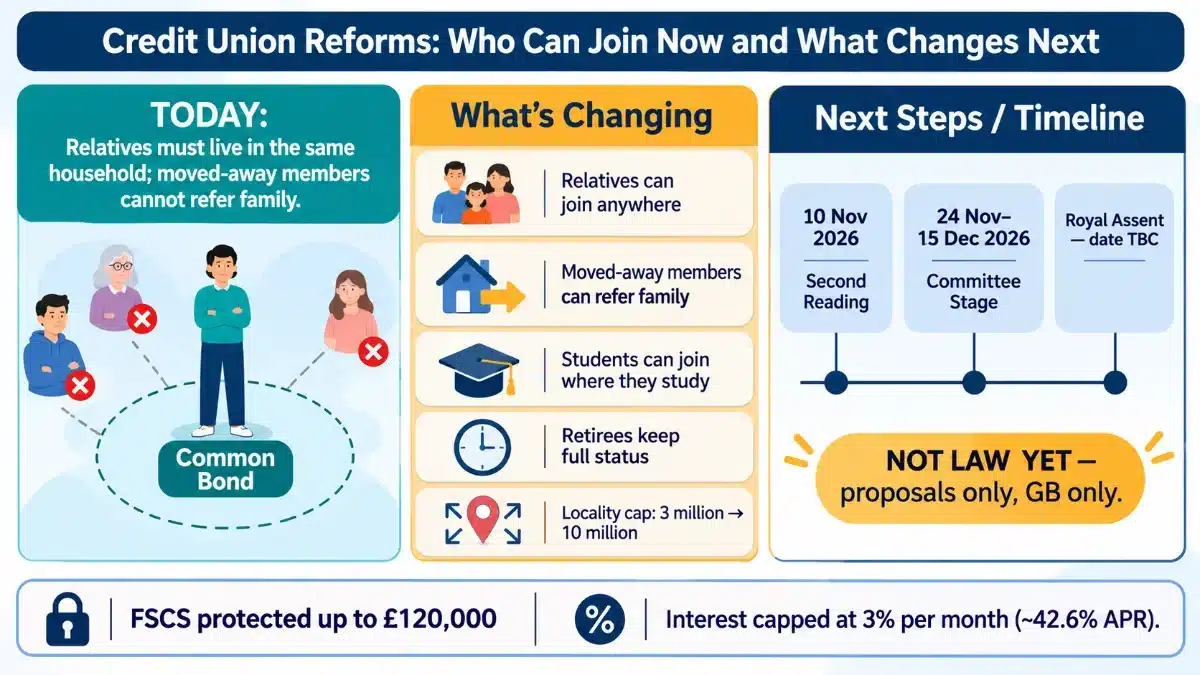
It sits alongside four reforms first set out in March 2026. Together they would widen who can join a credit union. Here is what is planned, what still applies today, and when it could become law.
Table of Contents
What changed on 11 November
Every credit union has a common bond: the membership rule that says who can join. Most are based on where you live or work. Others cover one employer, one occupation or one association.
If you joined because you lived in the area and then moved away, you can usually keep your account. But you become a “non-qualifying member”, and under current law a non-qualifying member cannot introduce family members. Only qualifying members can.
The 11 November announcement removes that block. A member who has moved away would still be able to refer a relative or a household member. Several credit unions and trade bodies had asked for exactly this in their responses to the Treasury’s 2024 call for evidence.
The full package of common bond changes
The other four changes were confirmed in a written ministerial statement on 18 March 2026 and the Treasury’s full response to the call for evidence.
| Rule | Today | Planned |
|---|---|---|
| Relatives of members | Can join only if they live in the same household as the member | Relatives can join wherever they live; household members can join too |
| Members who moved away | Become non-qualifying and cannot refer family | Can refer a relative or household member (announced 11 Nov 2026) |
| Students | Must live or work in the area to join a locality credit union | Students can join the locality credit union where they study |
| Retirees of employer or occupation credit unions | Lose qualifying status on retirement; cannot join once retired | Keep full status, can refer family, and can join after retiring |
| Size of a locality credit union | Potential membership capped at 3 million people | Cap raised to 10 million |
The cap matters more than it looks. Locality credit unions make up 79% of the sector, according to the March statement. In big cities the 3 million limit has stopped some mergers, which can leave areas with no credit union at all.
Nothing has changed yet
These are proposals. The membership rules sit in the Credit Unions Act 1979, so they need new legislation. The Financial Services and Markets Bill had its second reading on 10 November 2026. Its Public Bill Committee starts on 24 November and is expected to report by 15 December 2026. The bill then still needs to finish its Commons stages and receive Royal Assent.
Two more points are easy to miss:
- It’s Great Britain only. Credit unions in Northern Ireland come under a separate law, the Credit Unions (Northern Ireland) Order 1985.
- Each credit union decides. The common bond is written into each credit union’s own rules, registered with the FCA. The reforms let credit unions widen their membership; a credit union will still need to change its rules before you can use the new routes in.
The regulators are reviewing the rules too
On 3 November 2026 the Prudential Regulation Authority and the FCA published a joint discussion paper on credit union regulation. It notes that credit unions have over two million members in the UK.
The options include lighter paperwork for small credit unions, more flexible capital rules for large ones, a route to convert into a building society, and possible changes to FCA fees. None of this is decided; the regulators are asking for views.
The same bill also carries wider consumer changes, including a rewrite of much of the Consumer Credit Act and a 10-year time limit on complaints to the Financial Ombudsman Service. We covered the last big shake-up of credit rules in our guide to the FCA’s new BNPL regulations.
Why a credit union is worth checking
For borrowers with thin or damaged credit files, credit unions offer a regulated alternative to high-cost lenders. Two facts are fixed by law:
- Interest is capped. A credit union in Great Britain cannot charge more than 3% a month on the outstanding balance, including fees, under the Credit Unions (Maximum Interest Rate on Loans) Order 2013. That works out at about 42.6% APR at most. Rates vary between credit unions, so compare the rate you’re offered.
- Savings are protected. Money in a PRA-authorised credit union is covered by the FSCS up to £120,000 per person, the same as a bank.
For the other end of the market, see our report on the FCA’s restrictions on six unregulated lenders, and our stress test of salary advance apps for the costs of the alternatives.
Can you join a credit union today?
Under the rules in force now, you can usually join if you:
- live or work in the area a locality credit union covers
- work for an employer, or in an occupation, that a credit union serves
- belong to an association with its own credit union
- live in the same household as a relative who is a qualifying member
If a relative is a member but lives elsewhere, ask the credit union whether it plans to adopt the new rules once the bill passes. Parents thinking about savings for children may also find our guide to Child Trust Funds and young adults who lack capacity useful.
FAQ
What is the credit union common bond?
It is the membership rule each credit union must state in its rules: for example, living or working in an area, working for one employer, or belonging to an association. Only people inside the common bond, and certain relatives, can join.
Can my children join my credit union if they don’t live with me?
Not under current law. The planned reform would allow relatives to join wherever they live, once the law changes and your credit union updates its rules.
I moved away from my credit union’s area. Can I keep my account?
Usually yes, as a non-qualifying member. The 11 November proposal would also let you refer a relative or household member, which you cannot do today.
When will the new rules start?
No date has been set. The changes need the Financial Services and Markets Bill to pass. Its Commons committee stage is due to finish by 15 December 2026, and it still needs Royal Assent after that.
Do the changes apply in Northern Ireland?
No. They cover Great Britain. Northern Ireland’s credit unions are governed by separate legislation.
What is the most a credit union can charge on a loan?
3% a month on the reducing balance, which is about 42.6% APR, including any fees.
Sources: HM Treasury, “Affordable finance access for tens of thousands more people” (11 November 2026); Written Ministerial Statement HCWS1418 (18 March 2026); HM Treasury, Credit Union Common Bond Reform Call for Evidence Response (18 March 2026); UK Parliament, Financial Services and Markets Bill call for evidence (11 November 2026); Bank of England, “Regulators explore credit union reforms” (3 November 2026); FCA, Common bonds and objects for credit unions; Credit Unions (Maximum Interest Rate on Loans) Order 2013; FSCS, Banks, building societies and credit unions. All checked 12 November 2026.


Recent Comments