




Last updated: 23 November 2026
On 23 November 2026 the Financial Conduct Authority published a review of how financial advisers, wealth managers and investment platforms treat families after a death. It found good practice at some firms, and confusing letters, slow cases and fees for services nobody was receiving at others.
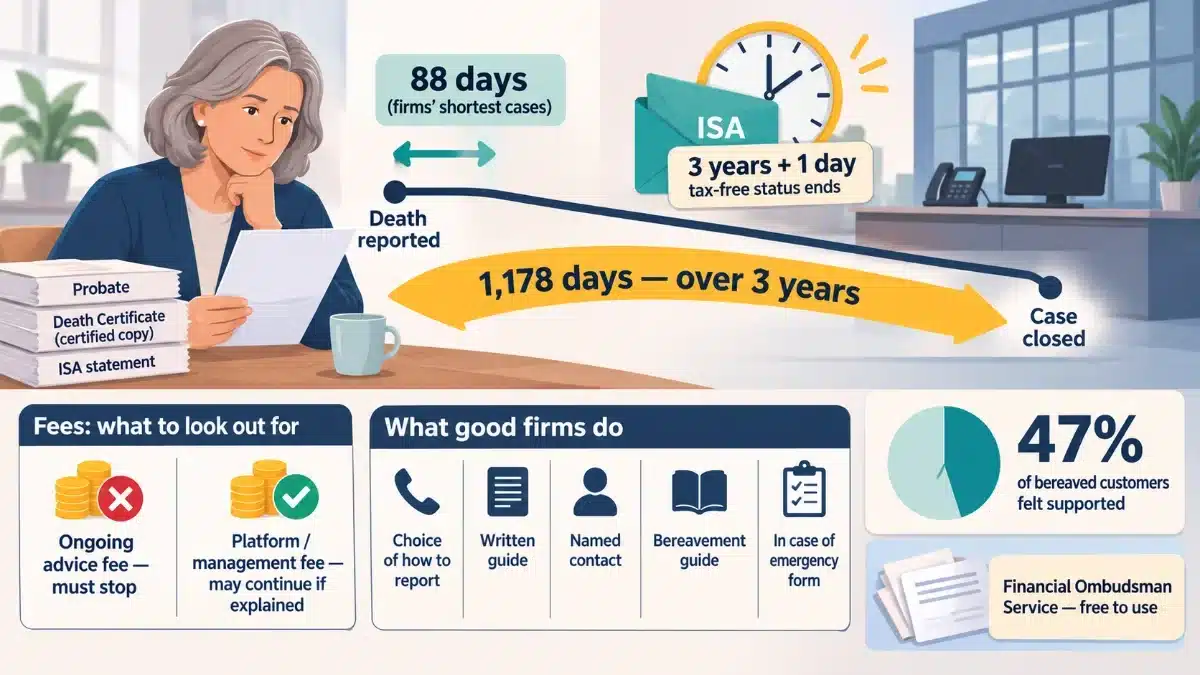
The headline figure is stark. Among the slowest cases firms reported, the median time from the death being reported to the case being closed was 1,178 days. That is more than three years, and three years is also the point at which a deceased person’s ISA loses its tax-free status.
This guide explains what the regulator now expects, what happens to ISAs and other investments when someone dies, and what you can ask a firm to do if your case is stuck.
Table of Contents
Contents
- What the FCA found
- My adviser is still charging fees after the death: is that allowed?
- What happens to an ISA when a person dies?
- Are investment accounts frozen when someone dies?
- The three-year problem with slow cases
- What to ask the firm, step by step
- If the firm is too slow or charges you wrongly
- FAQ
What the FCA found
The FCA started the review in May 2026. It looked at bereavement records, case procedures and 36 case summaries from firms that advise on, manage or administer investments. It also used complaints and case data covering 1 May 2025 to 30 April 2026.
The review was judged against the Consumer Duty, the rule that requires firms to deliver good outcomes for retail customers. It follows similar FCA reviews of retail banks and life insurers.
| Finding | Figure or example |
|---|---|
| UK adults who lost a close family member in the previous 12 months | 5% (FCA Financial Lives Survey) |
| Bereaved customers who felt financial firms gave them the support they needed | 47% (FCA-commissioned research) |
| Median of each firm’s 10 shortest cases, death reported to case closed | 88 days |
| Median of each firm’s 10 longest cases | 1,178 days |
| Complaints received per 100 bereavement cases | 2 |
| Ongoing adviser fees charged after a death | In some cases, until an original death certificate arrived |
The low complaint rate is not good news in the FCA’s reading. The regulator says grieving people may not feel able to complain, so firms cannot treat two complaints per 100 cases as proof that their service works.
Where firms fell short
- Paperwork. Some firms wanted the original death certificate by post. Others accepted an emailed copy that had been checked, and some accepted copies with no check at all.
- Mixed messages. Some families received unclear or conflicting information after reporting a death and did not know what to do next.
- Restricted contact. In some cases people could only report a death by phone if they were already a customer of the firm.
- Cold letters. Standard acknowledgement letters sometimes lacked empathy and gave only generic contact details.
- No deadlines. Some firms ticked off tasks on checklists but had no target times and no checks for delays.
- Charges buried in terms. People were sometimes left to search long terms and conditions to find out what they would pay.
What good firms already do
The review also names practices that worked. These are worth asking for by name:
- a choice of reporting a death by phone, email or online
- a written guide sent after the death is reported, setting out each step, the documents needed and where to get support
- a named contact who handles the case from start to finish
- a bereavement guide showing which charges stop and which continue
- an “in case of emergency” form that customers can fill in while alive, so their family can find accounts and details later
My adviser is still charging fees after the death: is that allowed?
Not for advice that is no longer being given. The FCA is direct on this point: ongoing advice fees must stop when the related service is no longer being provided to the customer who has died.
The review found that financial advisers generally did stop ongoing adviser charges once a death was reported. The problem cases were firms that kept charging until an original death certificate arrived, which meant charging for a period when no service was being delivered.
That does not mean every charge stops. The FCA says fees for continuing services can still apply, such as:
- managing the investments
- holding them on a platform
- providing the financial product itself
- administering the bereavement case
What firms must do is explain, at the start, which charges stop, which continue, what any new work will cost and whether costs come out of the estate or are billed separately. They must also be able to show that any charge for work after the death is allowed by the contract, and that it is fair value.
| Charge | After a death is reported |
|---|---|
| Ongoing advice fee | Must stop when the advice service is no longer provided |
| Platform or custody fee | Can continue while the investments are still held |
| Fund or investment management charges | Can continue while the investments are still managed |
| Bereavement administration or new work | Can apply, but must be explained up front and allowed by the contract |
If you have already paid advice fees for months after a death, ask the firm in writing for the date it was told of the death and a breakdown of every charge taken since. Then ask for a refund of any ongoing advice fee taken after that date.
What happens to an ISA when a person dies?
An ISA does not close on the day of death. Under the rules on GOV.UK, the account ends when the executor closes it or when the estate’s administration is completed. If neither happens first, the provider closes it 3 years and 1 day after the death.
Up to that point there is no Income Tax or Capital Gains Tax to pay on the ISA. The ISA still counts as part of the estate for Inheritance Tax.
For a stocks and shares ISA, the provider can be told to either:
- sell the investments and pay the money to the estate’s administrator or a beneficiary, or
- transfer the investments into the surviving spouse’s or civil partner’s ISA, but only if they use the same ISA provider
Who gets my ISA if I die?
The money goes through the estate to whoever inherits under the will (or the intestacy rules if there is no will). A surviving spouse or civil partner also gets an extra ISA allowance. For deaths on or after 6 April 2018, they can add a tax-free amount equal to either the value of the ISA at death or its value when closed, on top of their normal £20,000 allowance. The account becomes a “continuing account of a deceased investor” in the meantime, and no new money can go in.
This extra allowance is easy to miss when you are dealing with everything else. Ask the provider about it directly.
Are investment accounts frozen when someone dies?
In practice, yes for most purposes. Once a firm is told of a death, the account is restricted until someone with legal authority, usually the executor or administrator, gives instructions. Nobody can trade or withdraw from it in the meantime on the deceased person’s behalf.
Whether you need probate depends on the firm. GOV.UK says every organisation has its own rules, and you should contact each financial organisation to find out whether it needs a grant of probate before releasing money. Investments held jointly with someone else usually pass to the surviving owner.
The FCA review adds an important point: paperwork should match the task. Recording a death or pausing charges may need less evidence than transferring investments or paying money to the estate. A firm asking for the full set of legal documents just to log the death is the kind of thing the regulator wants to end.
The three-year problem with slow cases
Here is the angle most coverage of the review misses. The FCA compared each firm’s 10 shortest and 10 longest cases. The median for the longest cases was 1,178 days, which is about 3.2 years.
That matters because of the ISA rule above. If an ISA is still open three years and one day after the death, the provider closes it. From that point the tax-free wrapper no longer covers the money, so any income or gains after closure can be taxable for the estate or beneficiaries.
Firms said complex products and probate requirements explain many long cases, and some delays are outside a firm’s control. The FCA’s answer is that firms must track case times more closely, build in review points and take account of deadlines “like tax payment”.
Our reading (an inference, not an FCA statement): if you are an executor and an estate looks likely to run past two years, ask each ISA provider now what date the account will close and what happens to the investments then. That leaves time to decide whether to sell, transfer or move the holdings before the wrapper ends.
What to ask the firm, step by step
These questions come straight from what the FCA says firms should provide. Use them when you first report the death, by email so you have a record.
- Who is my named contact? Ask for one person or team responsible for the case from start to finish.
- Will you accept a certified or checked copy of the death certificate? Ask which documents you need now and which only later, for example for a transfer or payout.
- Which charges stop today, and which continue? Ask for the list in writing, with the reason for each continuing charge.
- Has the ongoing advice fee stopped? If not, ask why, and from what date it will be refunded.
- Do you need probate for this account? Ask for the threshold or rule the firm uses.
- What happens to the ISA, and on what date will it close? Ask about the surviving spouse’s extra ISA allowance if that applies.
- How long do your cases usually take, and how will you update me? Ask for a target time and how often you will hear from them.
- What support do you offer? The FCA says firms should tell people where to find independent bereavement support.
If someone close to you is still alive and willing, the “in case of emergency” idea from the review is worth copying at home: a single list of every platform, pension, ISA and adviser, with account numbers kept somewhere safe. For pensions, the coming pensions dashboard should make lost pots easier to find, but it is not live for the public yet.
If the firm is too slow or charges you wrongly
Start with a written complaint to the firm, quoting the FCA’s review and the Consumer Duty. Be specific: the date the firm was told of the death, the charges you dispute and the delays you have faced.
If the firm does not put it right, executors and beneficiaries can usually take the complaint to the Financial Ombudsman Service, which is free to use. Keep copies of every letter and email.
The FCA says it will work with firms, trade bodies, bereavement organisations and consumer groups to improve support across the industry. It has not announced new rules or fines alongside this review. The expectations rest on the Consumer Duty, which already applies.
Related reading on TFM
- Partial pension transfers: which UK providers allow them
- Workplace pension charge cap and performance fees
- Child Trust Funds when a young person lacks capacity
- SJP Diversified Assets fund suspended: what investors can do
FAQ
Should financial advisers stop charging when a client dies?
Ongoing advice fees must stop when the advice service is no longer provided, according to the FCA’s November 2026 review. Fees for services that continue, such as holding or managing the investments, can still apply if the firm explains them.
What happens to an ISA when a person dies?
It stays tax-free as a “continuing account of a deceased investor” until the executor closes it, the estate is finalised, or 3 years and 1 day pass. It still counts towards Inheritance Tax.
Can investments be transferred on death instead of sold?
Yes, in many cases. A stocks and shares ISA can be moved into a surviving spouse’s or civil partner’s ISA if they use the same provider. Other holdings can often be transferred to beneficiaries once the executor gives instructions.
Are investment accounts frozen when someone dies?
The firm restricts the account once it is told of the death. The executor or administrator then gives instructions, and some firms need probate first.
Does a firm need the original death certificate?
Not always. The FCA found practice varied, with some firms accepting checked emailed copies. It wants paperwork kept proportionate, asking only for what is needed at each stage.
How long does it take to release investments after a death?
It varies widely. In the FCA’s sample, the median of the shortest cases was 88 days and the median of the longest was 1,178 days.
Sources: FCA, Support after a bereavement: what consumer investment firms do well and where they need to improve (23 November 2026); FCA press release, 23 November 2026; GOV.UK, ISAs: if you die; GOV.UK, inheriting an ISA from your spouse or civil partner; GOV.UK, applying for probate.
This article is general information, not financial or legal advice. Estates differ; executors with complex estates should consider professional advice.


Recent Comments