


Last updated: 9 November 2026
You can move part of a UK workplace or personal pension to another provider, but only if your current provider’s scheme rules allow it. Many don’t. We checked the published rules of 17 UK pension providers and products: six say yes (mostly SIPPs and personal pensions), two say no or “usually no”, one leaves it to your employer, and the other eight don’t publish an answer.
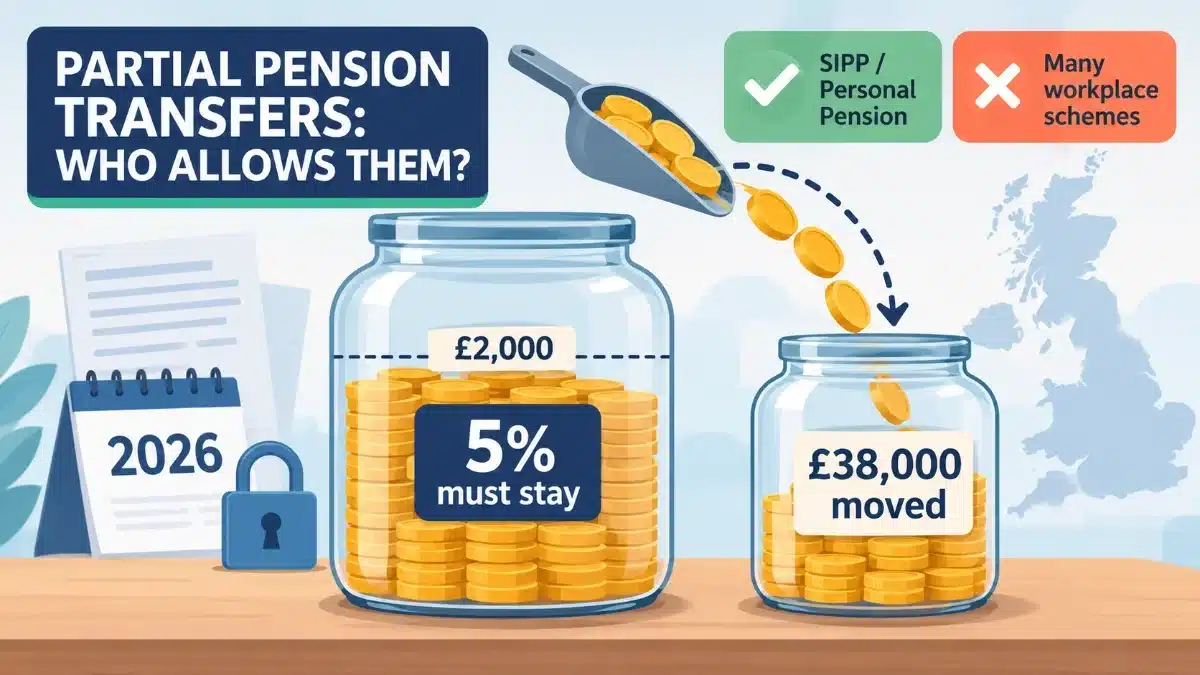
That gap matters. On a £40,000 pot, the difference between a provider that keeps back 5% and one that keeps back £10,000 is £8,000 left behind in the old scheme.
Table of Contents
Contents
- What the law actually allows
- Provider by provider: who allows partial transfers out
- Worked example: moving £30,000 of a £40,000 pot
- Five catches that can cost you
- What the 2026 pension reforms change (and don’t)
- How to ask for a partial transfer
- FAQ
What the law actually allows
There is no legal right to move only part of a defined contribution (DC) pension. The statutory transfer right in the Pension Schemes Act 1993 is built around your whole “cash equivalent”. Section 96 says you can split that value between different destinations, but the choice has to be made “in relation to the whole of that cash equivalent”.
Tax rules are more relaxed. HMRC’s Pensions Tax Manual (PTM100010) says that if the scheme rules allow, “only part of a member’s uncrystallised rights” can be transferred as a recognised transfer.
Two limits follow from that:
- Only money you haven’t touched. “Uncrystallised” means you haven’t taken tax-free cash or income from it yet.
- Not a drawdown pot in pieces. HMRC says a partial transfer of a pension in payment is an unauthorised payment, and that a drawdown fund must move in full to a new arrangement (PTM104000).
So the real gatekeeper is your provider’s scheme rules. That’s why the answers below vary so much.
Provider by provider: who allows partial transfers out
We read each provider’s own help pages, transfer forms or key features documents on 9 November 2026. “Not stated” means we couldn’t find a published answer on the provider’s site, not that the answer is no. Ask the provider before you start.
| Provider / product | Partial transfer out? | Conditions published |
|---|---|---|
| PensionBee | Yes | 5% of the pot must stay; no exit fee |
| Vanguard Personal Pension (SIPP) | Yes, untouched money only | £10,000 must remain; to other authorised schemes |
| AJ Bell SIPP | Yes, untouched part only | Any accessed part must move in full |
| Aegon SIPP | Yes, SIPP only | At least £1,000 must remain; no drawdown funds |
| Legal & General Personal Pension | Yes | At least £100 must remain |
| Legal & General workplace | Only if your employer’s scheme allows | Minimum £2,000 moved; £100 must remain |
| Aviva Platform (adviser platform pension) | Yes, form has a “partial” option | No partial transfers once in drawdown |
| NOW: Pensions | No | Whole account only; must stop paying in first |
| The People’s Pension | Usually no | “Usually” whole pot; no transfer charge |
| Nest | Not stated (whole pot implied) | Must have stopped contributing; no fee |
| Aviva workplace | Not stated | Leaving guide refers to the whole pot |
| Scottish Widows | Not stated | No transfer charge; with-profits may face a market value reduction |
| Aegon workplace (TargetPlan) | Not stated | No transfer penalties |
| Royal London | Not stated | No transfer fee |
| Standard Life | Case by case | No product rule published |
| Hargreaves Lansdown SIPP | Not stated for UK transfers | No exit fees |
| Smart Pension | Not stated | None published |
The pattern is clear. The big auto-enrolment master trusts, where most workplace savers sit, either refuse or stay silent. The providers that say yes are mostly self-invested personal pensions (SIPPs) and app-based pensions, where you already pick your own investments.
The ones that say yes
PensionBee has the simplest rule we found. Its FAQ says partial transfers are allowed “but 5% needs to be left in the pot”. The receiving provider has to request it.
Vanguard allows partial transfers of uncrystallised money from its Personal Pension, according to its key features document (November 2025), as long as £10,000 stays behind. That’s a high floor for smaller pots.
AJ Bell lets you choose how much of the untouched part of your SIPP to move. Anything you’ve already accessed has to go in full.
Aegon‘s transfer-out form says partial transfers are “only available for SIPP”. If less than £1,000 would be left, Aegon can transfer the lot and close the account.
Legal & General is the only big workplace provider we found that spells out partial-transfer numbers: if your scheme allows it, the minimum move is £2,000 and £100 must stay in the account.
The ones that say no
NOW: Pensions is the bluntest: “You can’t transfer some out and leave some in now:pensions.” You also need to have stopped paying in.
The People’s Pension says you “usually have to move all of your pension in one go”. The word “usually” leaves some room, so ask.
Nest, the government-backed scheme used by millions of auto-enrolled workers, doesn’t say no outright. Its help page explains that it transfers “the exact value of your pension pot”, which reads as all or nothing.
Worked example: moving £30,000 of a £40,000 pot
Say you have £40,000 untouched in one pension and want to move £30,000 to a cheaper or better-performing home, keeping the rest where it is. Maybe the old scheme has a guaranteed annuity rate or a protected tax-free cash amount you want to keep.
| Provider rule | Must stay behind | Most you could move | £30,000 possible? |
|---|---|---|---|
| PensionBee (5% stays) | £2,000 | £38,000 | Yes |
| Vanguard (£10,000 stays) | £10,000 | £30,000 | Yes, exactly |
| Aegon SIPP (£1,000 stays) | £1,000 | £39,000 | Yes |
| L&G workplace, if allowed (£100 stays) | £100 | £39,900 | Yes |
| NOW: Pensions | n/a | £40,000 only | No, all or nothing |
Is it worth the effort? If the receiving pension costs 0.5 percentage points a year less, moving £30,000 saves about £150 a year before investment growth. Over a decade that adds up, but check exit charges and what you’d give up first.
Five catches that can cost you
1. You can lose protected tax-free cash
Some older pensions promise more than 25% tax-free cash. HMRC’s manual warns that a partial transfer can reduce or remove that protection. L&G says the same about its workplace plans. If your plan has a protected lump sum, get the figure in writing before you move anything.
2. Drawdown money must move in one block
Once you’ve started drawing an income, HMRC rules stop you splitting that fund. Aviva puts it plainly: once a pension is in drawdown or converted to an annuity, “it’s not possible to transfer part of it”. AJ Bell and Aegon apply the same limit.
3. With-profits funds may carry a penalty
Scottish Widows and Royal London don’t charge a transfer fee, but both mention a possible market value reduction on with-profits funds. That can cut what you move by several per cent, depending on market conditions.
4. Your new provider has to accept it
A partial transfer needs both ends to agree. Hargreaves Lansdown says you “may be able to” transfer only part of a pension in. Scottish Widows’ online Retirement Account lists “You only want to transfer part of your pension” as a reason it can’t accept a transfer, although its Platform form does have a partial option.
5. Scam checks still apply
Since 30 November 2021, trustees must check statutory transfers for red and amber flags, such as cold calls or an incentive to move. A red flag can stop the transfer. An amber flag means you must attend a MoneyHelper scams guidance appointment first. Nest’s own page says you may need one. Nobody legitimate will pressure you to move a pension quickly.
What the 2026 pension reforms change (and don’t)
The Pension Schemes Act 2026 became law on 29 April 2026. It brings in three changes that touch transfers, but none gives you a right to a partial transfer.
| Reform | What it does | Status (9 Nov 2026) |
|---|---|---|
| Small pots consolidation | Default auto-enrolment pots of £1,000 or less with no contributions for 12 months move automatically to a consolidator | DWP consultation closes 17 November 2026; regulations to follow |
| Value for Money assessments | Schemes rated each year; members in poor-value schemes may be moved | Framework overview published 11 August 2026 |
| Guided Retirement (default pension income) | Schemes must offer a default retirement income to savers approaching retirement | Consultation runs 3 November to 22 December 2026 |
The small pots consultation even notes how hard it is to “isolate and transfer only a portion of a member’s pot”. The DWP announcement of 3 November, which said around 17 million private sector workers would be offered an income in retirement, doesn’t mention transfers at all.
For now, then, partial transfers stay a provider choice. On the MoneySavingExpert forum this week, a saver argued that partial transfers should be a government-mandated feature of every workplace pension. Nothing in the current plans does that.
For a similar story about rules limiting what you can move, see our guide to transferring a stocks and shares ISA to a cash ISA.
How to ask for a partial transfer
- Check what you’re giving up. Ask your current provider for any protected tax-free cash, guaranteed annuity rate, with-profits bonus or exit charge. Ask for it in writing.
- Ask the old provider directly: “Do my scheme rules allow a partial transfer of uncrystallised funds? What is the minimum amount, and what must remain?”
- Ask the new provider whether it accepts partial transfers in. Most transfers are requested from the receiving end.
- Stop contributions if required. NOW: Pensions and Nest require you to have stopped paying in before any transfer out.
- Start the transfer from the new provider, stating the exact amount. Vanguard says pension transfers take from 10 working days to 10 weeks.
- Watch for scam flags. Never move a pension because of a cold call, a “free pension review” or a cash incentive.
If you hold investments with a smaller firm, our coverage of Jarvis Investment Management’s special administration shows why it’s worth knowing how transfers work before you need one. Fund suspensions can also freeze part of a pot, as SJP Diversified Assets fund investors found in October. And if you’re weighing up a pension app, our Scottish Widows app review covers what its app can and can’t do.
This article explains provider rules. It isn’t personal advice. If your pension has guaranteed benefits (such as a defined benefit pension or a guaranteed annuity rate) worth more than £30,000, the law requires regulated advice before a transfer. Free, impartial guidance is available from MoneyHelper and, if you’re 50 or over, Pension Wise.
FAQ
Can I transfer part of my pension to another provider?
Yes, if your current scheme’s rules allow it and the money hasn’t been accessed yet. HMRC allows partial transfers of uncrystallised funds, but providers decide whether to offer them.
Does Nest allow partial transfers?
Nest doesn’t publish a partial-transfer option. Its help page describes transferring the exact value of your pot, and you must have stopped contributing first.
Does NOW: Pensions allow partial transfers out?
No. NOW: Pensions says you can only transfer the whole account, and you can’t move some out while leaving some in.
Can I transfer part of a pension I’ve already started drawing from?
Not in pieces. HMRC treats a partial transfer of a pension in payment as an unauthorised payment. A drawdown fund has to move in full.
Will a partial transfer affect my tax-free cash?
It can. If your plan has protected tax-free cash above 25%, moving part of it may reduce or remove that protection. Ask your provider before you transfer.
Is there a fee for a partial transfer?
Most providers we checked charge no transfer-out fee, including Nest, The People’s Pension, Royal London, Scottish Widows and PensionBee. With-profits funds may carry a market value reduction.
Sources: Pension Schemes Act 1993, s.96; HMRC PTM100010; HMRC PTM104000; Conditions for Transfers Regulations 2021; The Pensions Regulator: Pension Schemes Act 2026; DWP small pots consultation; DWP, 3 November 2026; provider pages: PensionBee, Vanguard key features, AJ Bell, Aegon SIPP form, Legal & General, NOW: Pensions, The People’s Pension, Nest, Aviva, Scottish Widows, Royal London, Hargreaves Lansdown.


Recent Comments