



Last updated: 15 November 2026
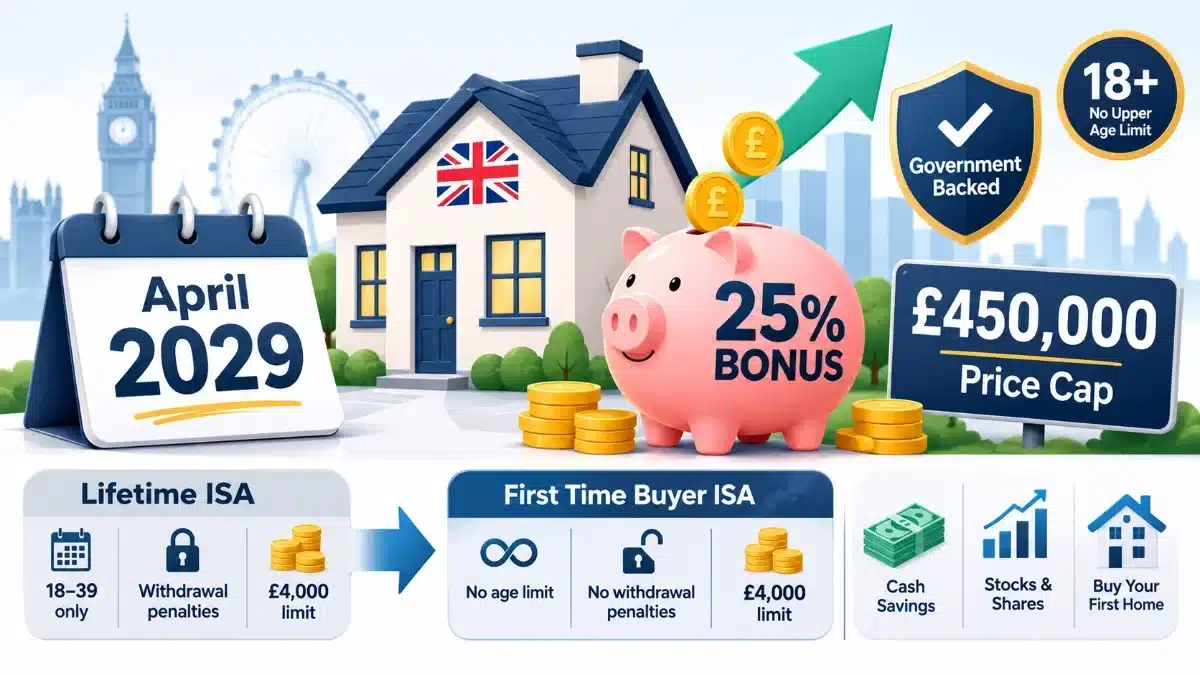
The First Time Buyer ISA is a new government-backed savings account for people buying their first home. It will replace the Lifetime ISA from April 2029, keep the 25% government bonus and the £450,000 price cap, and remove both the age limit and the withdrawal penalty.
HM Treasury confirmed the design alongside the Budget on 28 October 2026. You cannot open one yet. This guide covers how the account will work, what it means for your savings in pounds, what to use in the meantime, and the details the government has still to settle.
Table of Contents
Contents
- What is the First Time Buyer ISA?
- The rules, side by side with the Lifetime ISA
- Can I open a First Time Buyer ISA account now?
- How much bonus would I get? Three examples
- The Lifetime ISA change that started on 29 October
- What it means if you already save
- Timeline: every date that matters
- What the government has not decided yet
- FAQ
What is the First Time Buyer ISA?
It is an individual savings account you pay into for a first home. You can save up to £4,000 a tax year, in cash or in stocks and shares. When you use the money to buy your first home, the government adds a bonus of 25% of the final balance, up to £20,000.
The Treasury says it will be offered “in place of the Lifetime ISA”. Existing Lifetime ISAs carry on under their current terms. It is a new product, not a rebrand, so a Lifetime ISA cannot be converted into one.
The government consulted from 22 June to 18 August 2026. Its response says the consultation showed “broad but conditional support”, with respondents asking for a simple, stable design that fits existing ISA systems.
The rules, side by side with the Lifetime ISA
| Feature | First Time Buyer ISA (from April 2029) | Lifetime ISA (today) |
|---|---|---|
| Who can open | Anyone 18 or over, no upper age limit | Aged 18 to 39 |
| Annual limit | £4,000 (counts towards the £20,000 ISA allowance) | £4,000 (same) |
| Bonus | 25% of the final account balance, up to £20,000 in total | 25% of what you pay in, up to £1,000 a year |
| When the bonus is paid | On the home purchase (see the note below) | Monthly, into the account |
| Property price cap | £450,000 | £450,000 |
| Minimum holding period | 1 year | 12 months from first payment |
| Mortgage required | Yes | Yes |
| Withdrawal charge | None on a qualifying purchase | 25% (20% for first homes above £450,000 from 29 Oct 2026) |
| Transfers out | All transfers out allowed | Allowed, but a charge applies unless to another LISA |
| Use for retirement | Not part of the published design | Yes, from age 60 |
| Account types | Cash and stocks and shares | Cash and stocks and shares |
A note on bonus timing. The government’s response is not consistent. Section 2.4 says the bonus is “paid when funds are withdrawn for an eligible first home purchase”, while the summary table in chapter 3 says “bonus paid at exchange”. Either way, buyers will have 90 days from claiming the bonus to complete. Expect the final rule in the legislation.
Two more details matter in practice. You can hold only one First Time Buyer ISA at a time, and moving between providers means transferring the full balance. You can also transfer money in from other ISAs, but only up to the £4,000 yearly limit.
Can I open a First Time Buyer ISA account now?
No. The account starts in April 2029, and no bank or platform is offering one yet. The Treasury says it will be delivered by “multiple providers”, but none has been named.
If you are saving for a first home today, these are the options:
| Option | Who it suits | Main catch |
|---|---|---|
| Lifetime ISA | Aged 18 to 39, buying a home up to £450,000 at least 12 months from now | 25% charge if you withdraw for anything else before 60 |
| Help to Buy ISA | Existing holders only (closed to new savers) | Cannot be opened if you do not already have one |
| Cash ISA or savings account | Over 40s, or anyone who may not buy, or is buying above £450,000 | No government bonus |
| Your First Home scheme | Buying a new-build in England with a small deposit | An equity loan, not savings; applications open from February 2027 |
A Lifetime ISA opened now does not lose out when the new account arrives. The government says existing accounts continue on their current terms, and you can use a Lifetime ISA and a First Time Buyer ISA towards the same purchase.
The Your First Home scheme is separate. It offers a government equity loan of 20% of the price on a new-build home in England, with a deposit of at least 2.5%, for households earning £110,000 or less outside London or £140,000 or less in London. The loan is interest-free for five years, then 1.5% in year six and 3% from year seven. First sales are expected in April 2027. The guidance does not yet say whether it can be combined with a Lifetime ISA.
How much bonus would I get? Three examples
These examples assume the published design does not change before 2029.
1. Saving the maximum for three years
You pay in £4,000 a year for three years, £333 a month, into a cash account earning 4% AER. After three years the balance is about £12,770. The bonus is 25% of that: about £3,192.
A Lifetime ISA with the same £12,000 paid in earns a £3,000 bonus, plus interest on the bonus as it arrives. In a cash account, the two end up close. The new account’s advantages are elsewhere.
2. A 42-year-old who could not open a Lifetime ISA
You save £300 a month for four years, £14,400 in total, at 4%. The balance reaches about £15,640, and the bonus is about £3,910. Today, someone over 40 who never opened a Lifetime ISA gets no bonus at all. This is the group that gains most.
3. Reaching the £20,000 bonus cap
The bonus is capped at £20,000, which you reach when the account is worth £80,000. At £4,000 a year that takes many years of saving plus growth, so the cap will only matter for long-term savers in stocks and shares.
Interest and growth figures are illustrations, not forecasts. Rates change, and stocks and shares can fall as well as rise.
The Lifetime ISA change that started on 29 October
Until now, a Lifetime ISA saver whose first home cost more than £450,000 paid the standard 25% charge. Because the charge applies to the whole pot, it took back the bonus and a slice of the saver’s own money.
From 29 October 2026, the charge for these purchases is 20%, which recovers the bonus while you keep your own contributions. The 25% charge still applies to other unauthorised withdrawals.
| Example: £12,000 paid in, £3,000 bonus, home costs £475,000 | Before 29 Oct | From 29 Oct |
|---|---|---|
| Pot | £15,000 | £15,000 |
| Withdrawal charge | £3,750 (25%) | £3,000 (20%) |
| You receive | £11,250 | £12,000 |
| Own money lost | £750 | £0 |
One catch for stocks and shares Lifetime ISAs: the 20% is charged on the whole pot, including growth. If the same pot had grown to £16,500, the charge would be £3,300 and you would keep £13,200. That is your £12,000 back plus £1,200 of the £1,500 growth.
What it means if you already save
Lifetime ISA holders
Your account continues under its current terms. You cannot transfer a Lifetime ISA into the new account, because the government wants to avoid paying two bonuses on the same money. You can use both towards the same home.
The design also allows subscriptions into one account per tax year, “including a LISA or FTB ISA”. From April 2029, you may have to choose which one to pay into each year.
Help to Buy ISA holders
You get a dedicated window. Between 6 April 2029 and 1 December 2030, you can move your full Help to Buy ISA balance into a First Time Buyer ISA without it counting towards the £4,000 limit. The £450,000 price cap then applies to that money too.
Over-40s, and anyone not sure they will buy
If you are 40 or over, there is no bonus product for you today. From April 2029 there will be. And because a qualifying purchase carries no withdrawal charge, the new account is less risky than a Lifetime ISA for anyone who might change their plans, although the government has not yet said how other withdrawals will be treated.
Timeline: every date that matters
| Date | What happens |
|---|---|
| 28 October 2026 | Government confirms the First Time Buyer ISA design at the Budget |
| 29 October 2026 | Lifetime ISA charge falls to 20% for first homes above £450,000 |
| End of December 2026 | Your First Home scheme: pre-registration and guidance due |
| February 2027 | Your First Home scheme: first applications expected |
| April 2027 | Your First Home scheme: first sales expected |
| April 2029 | First Time Buyer ISA launches, in place of the Lifetime ISA |
| 6 April 2029 to 1 December 2030 | Help to Buy ISA balances can move across outside the £4,000 limit |
What the government has not decided yet
- Exactly when the Lifetime ISA stops taking new accounts or new payments
- Whether the bonus is paid at exchange or on withdrawal for the purchase
- How joint purchases work, and how a “first-time buyer” is defined
- What happens if a purchase falls through after the bonus is claimed
- How withdrawals for other reasons will be treated
- Which banks and platforms will offer the account
The detail will follow in legislation. Until then, nothing changes for Lifetime ISA savers buying under the cap.
The Budget also kept the cash ISA limit at £20,000 and said the government will “explore a new ISA incentive” for first-time stocks and shares investors. If you hold cash inside a stocks and shares ISA, our guide to moving cash out before April 2027 covers the separate transfer rules. For first-time investors weighing a platform offer, see our reviews of the J.P. Morgan Personal Investing £100 offer and the Scottish Widows app £25 share dealing offer. Once you own, our guide on how to pay less mortgage interest picks up from there.
FAQ
When does the First Time Buyer ISA launch?
April 2029, according to the government’s consultation response published on 28 October 2026.
Can I open a First Time Buyer ISA account now?
No. No provider offers one yet. If you are 18 to 39, a Lifetime ISA is the closest option today, and it can be used alongside the new account later.
What is the best ISA for first-time buyers right now?
For most people aged 18 to 39 buying under £450,000, the Lifetime ISA, because it is the only account that adds a government bonus today. If you are 40 or over, or might buy above the cap, a cash ISA or a high-interest savings account avoids the withdrawal charge.
Is the Lifetime ISA being scrapped?
The First Time Buyer ISA will be offered in place of the Lifetime ISA from April 2029. Lifetime ISAs opened before then continue under their current terms.
Can I transfer my Lifetime ISA into a First Time Buyer ISA?
No. The government has ruled it out to avoid paying two bonuses on the same money, but you can use both accounts for the same home.
Is there an age limit on the First Time Buyer ISA?
You must be 18 or over to open one. There is no upper age limit.
Is the bonus paid on investment growth?
Yes. The 25% bonus is calculated on the final account balance, up to a maximum bonus of £20,000.
Can couples each use a First Time Buyer ISA?
The government has not yet said how joint purchases will work. With a Lifetime ISA, each buyer can use their own account towards the same home.
What is the new Lifetime ISA withdrawal charge for homes over £450,000?
20%, for first-home purchases above the cap made on or after 29 October 2026. Other unauthorised withdrawals still face 25%.
This article explains government policy and is not personal financial advice.
Sources: HM Treasury, First Time Buyer ISA consultation and government response (28 October 2026); HM Treasury, First Time Buyer ISA: government response (PDF); HMRC, Lifetime ISA withdrawal charge (28 October 2026); HM Treasury, Budget 2026; GOV.UK, Lifetime ISA; GOV.UK, Your First Home (28 October 2026). Example figures calculated by The Fintech Mag.


Recent Comments