




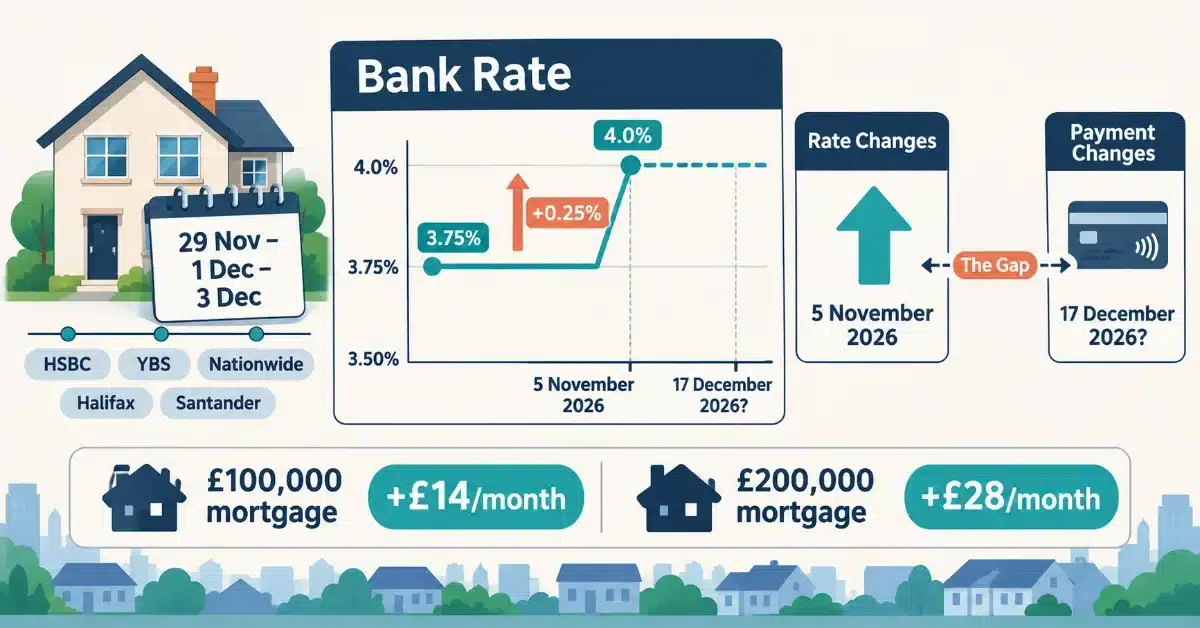
On 5 November 2026 the Bank of England raised Bank Rate from 3.75% to 4%, its first rise in more than three years. If you have a tracker mortgage, your rate goes up by the same 0.25 percentage points. What most coverage skips is when. Each lender applies the rise on its own date, and the date your rate changes is not always the date your monthly payment changes.
That gap matters. At one big building society, your rate rises at the end of November but your payment stays the same until March 2027 unless you ask. The difference does not disappear. Below is what each major lender has said, what the rise costs per £100,000, and how to decide whether to stay on a tracker or fix.
Last updated: 15 November 2026
Table of Contents
Contents
- What happened on 5 November
- When each lender passes on the rise
- My tracker went up: when will my payment change?
- How much more you will pay per £100,000
- The YBS catch: rate now, payment later
- Should I switch my tracker to a fixed rate now?
- What to do this month
- FAQ
What happened on 5 November
The Monetary Policy Committee voted 8–1 to raise Bank Rate by 0.25 percentage points to 4%. The one dissenting member wanted a bigger rise, to 4.25%. The Bank’s November 2026 Monetary Policy Summary points to inflation: CPI rose to 3.5% in September.
The next decision is due on 17 December 2026. Nobody voted to hold this time, which is why tracker borrowers are asking whether another rise is coming before Christmas.
A tracker mortgage is set as Bank Rate plus a fixed margin. If your deal is Bank Rate + 0.50%, you were paying 4.25% and you will now pay 4.50%. Fixed-rate borrowers see no change until their deal ends.
When each lender passes on the rise
We checked each lender’s own base rate page on 15 November 2026. Where a lender had not published a date, we say so rather than guess.
| Lender | Tracker rate changes | Monthly payment changes | Variable rate (SVR) change |
|---|---|---|---|
| HSBC | Within a day of the Bank’s decision | From the following month’s payment (HSBC’s own example: rate changes 1 Nov, payment due 5 Nov, new amount from 5 Dec) | Not stated on its page |
| Yorkshire Building Society | 29 November 2026 | Not until March 2027, unless you ask for a recalculation | Under review |
| Nationwide | 1 December 2026 | From December 2026, on your usual payment date | SMR 6.49% to 6.74%; BMR 5.75% to 6%, from 1 December |
| Halifax | Up 0.25% from 1 December 2026 | Not stated on its page | Standard Variable Rate and Homeowner Variable Rate 7.24% to 7.49%, from 1 December |
| Santander | Up 0.25% from 3 December 2026 (includes the Follow-on Rate, now 7.25%) | Not stated on its page | 6.50% to 6.75%, from 3 December |
| NatWest | No date published; NatWest trackers follow NatWest’s own Base Rate, not Bank Rate directly | NatWest says it will write if your payment changes | Not stated on its page |
Two things stand out. HSBC moves fastest, so its tracker customers pay the higher rate from early November. And NatWest’s trackers are tied to the bank’s own Base Rate, which “is influenced by” Bank Rate, according to NatWest’s base rate guide. If you are with NatWest, check the rate in Manage your Mortgage rather than assuming the date.
If your lender is not listed, its terms decide the date. Look for a “base rate change” page on its website, or the letter it has to send you before your payment changes.
My tracker went up: when will my payment change?
There are two dates in every rate change, and lenders do not always line them up.
- The rate date is when interest starts building at the new rate.
- The payment date is when your Direct Debit goes up to cover it.
At most big lenders the gap is a few weeks. Interest is often worked out daily, so your first payment after the change may include a part-month at the new rate. That is why the first new payment can look a little different from the ones after it.
Where the gap is longer, your payment is not covering all the interest being charged. The shortfall is added to what you owe. That is the trap at YBS, covered below.
How much more you will pay per £100,000
A 0.25-point rise adds roughly £14 to £15 a month per £100,000 on a 25-year repayment mortgage. On interest-only, it is £20.83 a month per £100,000.
| Mortgage (25 years, repayment) | Tracker 4.25% to 4.50% | Tracker 4.75% to 5.00% |
|---|---|---|
| £100,000 | £541.74 to £555.83 (+£14.09 a month) | £570.12 to £584.59 (+£14.47 a month) |
| £200,000 | £1,083.48 to £1,111.66 (+£28.19 a month) | £1,140.23 to £1,169.18 (+£28.95 a month) |
| £300,000 | £1,625.21 to £1,667.50 (+£42.28 a month) | £1,710.35 to £1,753.77 (+£43.42 a month) |
Over a year, that is about £170 per £100,000 borrowed. If you have less than 25 years left, the increase is slightly smaller, because more of each payment is already repaying the loan.
These are standard repayment-mortgage calculations at a fixed 25-year term. Your lender’s figure may differ by a few pounds depending on how it calculates daily interest and your remaining term.
The YBS catch: rate now, payment later
Yorkshire Building Society’s base rate change page says tracker rates for existing customers rise on 29 November 2026, but payments “won’t change until March 2027, unless you contact us”. If you do nothing, you are charged the higher rate from 29 November while your payment stays the same.
That means you underpay the interest for about three months. On a £200,000 mortgage, the extra interest from a 0.25-point rise is about £41.67 a month. Over December, January and February, that is roughly £125 added to your balance. Your payment from March is then recalculated on the larger balance.
The amount is small, but it is avoidable. YBS lets you request a payment recalculation online so the higher payment starts sooner. If you would rather pay as you go than catch up later, ask for it now.
Should I switch my tracker to a fixed rate now?
Trackers are still cheaper than fixes on most deals. According to Moneyfacts, the average two-year tracker was 4.68% at the start of November, more than one percentage point below the average two-year fix.
On a £200,000 mortgage over 25 years, a one-point gap is worth about £118 a month (£1,132.20 at 4.68% against £1,249.77 at 5.68%). Base rate would need to rise by roughly a full point, four more quarter-point rises, before that tracker cost the same as the fix.
So the question is not “will rates rise again?” but “how far, and how fast?”. Three checks help:
- Your early repayment charge. Many trackers have none, so you can move to a fix at any time without a penalty. Check your offer. If your tracker has no charge, you can wait and watch the 17 December decision.
- Your budget headroom. Work out what your payment would be at Bank Rate 4.5% or 5%. If that would hurt, the certainty of a fix is worth paying for.
- Your deal’s end date. If your tracker ends within six months, you can usually reserve a new deal now and switch when it ends.
This is not advice for your circumstances. A fee-free mortgage broker can compare your lender’s product transfer with the wider market on total cost. For other ways to cut what you pay, see our guide on how to pay less mortgage interest in the UK.
What to do this month
- Find your mortgage type and margin. Your offer or annual statement shows whether you are on a tracker, the margin above Bank Rate and any rate floor.
- Find your lender’s dates. Use the table above or your lender’s base rate page. Note both the rate date and the payment date.
- Check your Direct Debit has room. Budget about £15 a month more per £100,000 borrowed from your next statement.
- If you are with YBS, decide on recalculation. Either ask for the higher payment now, or accept a slightly larger balance from March.
- Decide before 17 December. If another rise would stretch you, start a fixed-rate comparison now, while most trackers can be left without a penalty.
Halifax customers also have a separate change to plan for, with Halifax accounts moving to Lloyds. Our guide to what changes when Halifax moves to Lloyds covers it. If you are still saving for your first home, rate rises also feed into the deposit question; see our explainer on the First Time Buyer ISA.
FAQ
What is a tracker mortgage?
A tracker mortgage is a variable-rate deal set at Bank Rate plus a fixed margin, for example Bank Rate + 0.5%. When Bank Rate moves, your rate moves by the same amount, on the date set in your lender’s terms.
How much will my mortgage go up with the base rate rise?
On a 25-year repayment mortgage, about £14 to £15 a month for every £100,000 you owe. On interest-only, £20.83 a month per £100,000. A £200,000 repayment tracker goes up by about £28 to £29 a month.
Will my tracker go up straight away?
It depends on your lender. HSBC trackers change within a day. Yorkshire Building Society changes them on 29 November, Nationwide and Halifax on 1 December, and Santander on 3 December 2026. Your payment may change later than your rate.
Why hasn’t my mortgage payment gone up yet?
Most lenders need to write to you before your payment changes, so there is usually a gap of a few weeks. At YBS, payments stay the same until March 2027 unless you ask for a recalculation, even though the higher rate applies from 29 November.
Can I switch from a tracker to a fixed rate without a penalty?
Often yes, because many trackers have no early repayment charge. Check your mortgage offer. If there is a charge, compare it with what a fix would save before switching.
Is a tracker mortgage a good idea in 2026?
Trackers still start cheaper than most fixes, by more than a point on Moneyfacts’ November averages. They suit borrowers who can absorb further rises. If another quarter-point would strain your budget, a fix buys certainty.
What happens to my tracker if the base rate goes up again in December?
Your rate would rise by the same amount again, on your lender’s new effective date. The next Bank of England decision is on 17 December 2026.
Sources: Bank of England, Monetary Policy Summary and minutes, November 2026; HSBC UK, Bank of England base rate; Yorkshire Building Society, Bank of England Base Rate change; Nationwide, Bank of England base rate changes and your mortgage; Halifax, Bank of England base rate changes and your mortgage; Santander UK, Bank of England base rate change; NatWest, Bank of England base rate and your mortgage; Moneyfactscompare.co.uk, Bank of England base rate November 2026. Lender pages checked on 15 November 2026. Payment figures calculated by The Fintech Mag.


Recent Comments