


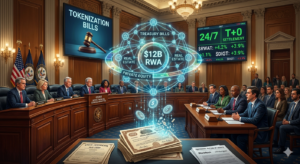
On Wednesday, March 25, 2026, at 10:00 AM EST (2:00 PM GMT), the U.S. House Financial Services Committee will convene a high-stakes hearing titled “Tokenization and the Future of Securities: Modernizing Our Capital Markets.” This event is widely seen as the most significant legislative step yet toward integrating blockchain technology into the bedrock of American finance.
Table of Contents
The $12 Billion RWA Opportunity
The hearing arrives as the market for **Real-World Assets (RWAs)**—the tokenization of traditional assets like treasury bills, real estate, and private equity—surpasses $12 billion in total value. Lawmakers are under increasing pressure from Wall Street institutions like BlackRock and J.P. Morgan to provide a clear legal framework for secondary market trading of tokenized securities.
“The technology is here, and the capital is ready,” noted one committee staff member. “The goal of this hearing is to determine how we can modernize our capital markets without compromising the investor protections that make the U.S. the world’s financial leader.”
Legislative Focus: The Pair of Bills
The committee is expected to take up a pair of critical bills designed to clarify the regulatory status of tokenized assets. The first aims to define “tokenized securities” as a distinct class within the Securities Act, while the second focuses on the role of transfer agents and the legal finality of blockchain-based settlements.
This follows the recent progress of the CLARITY for Stablecoins Act, signaling a coordinated push by Washington to establish a “Crypto-Native” financial infrastructure. If these bills gain bipartisan support, it could pave the way for 24/7/365 trading and T+0 (instant) settlement for traditional stocks and bonds.
What This Means for Fintech
The hearing is a watershed moment for the fintech industry. For builders in the RWA space, the outcome will determine whether the next generation of capital markets is built in the U.S. or migrates to more crypto-friendly jurisdictions like the EU or UAE.
- Market Structure: A positive outcome could trigger a flood of institutional grade RWAs onto public blockchains.
- Operational Efficiency: Tokenization could reduce administrative costs for private funds by as much as 40%.
- Global Leadership: The hearing serves as a statement of intent that the U.S. intends to remain the global hub for financial innovation.
Story Score: 8.5/10


Recent Comments