




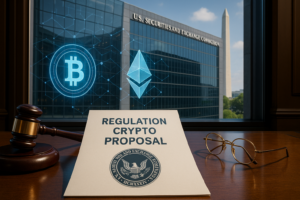
The United States Securities and Exchange Commission has taken a decisive step toward comprehensive cryptocurrency regulation by submitting its “Regulation Crypto” proposal to the White House Office of Information and Regulatory Affairs. SEC Chair Paul Atkins announced the milestone during his keynote address at the Vanderbilt University Digital Assets and Emerging Tech Policy Summit on April 7, 2026, marking the most significant regulatory advancement for digital assets since the agency began grappling with the sector’s explosive growth.
Table of Contents
The “Regulation Crypto” Framework: A Securities Act Modernization
The SEC’s “Regulation Crypto” proposal represents a targeted modernization of the Securities Act of 1933, specifically addressing fundraising exemptions and startup innovation within the cryptocurrency ecosystem. SEC Chair Paul Atkins emphasized that the framework aims to establish clear delineations between transactions that constitute securities and those that do not, addressing years of regulatory ambiguity that has plagued the industry. “We’d love to have reactions and everything else,” Atkins stated during his Nashville presentation. “It’s not a rule as such but obviously we need to know how it’s functioning and if people have problems with it or not.”
Key Components of the Regulatory Proposal
The “Regulation Crypto” framework incorporates several critical elements designed to balance innovation with investor protection:
- Fundraising Exemptions: Specific provisions for cryptocurrency startups seeking capital through token offerings while maintaining compliance with existing securities laws.
- Innovation Exemption: A long-awaited regulatory pathway that the SEC plans to release concurrently, allowing experimentation within defined parameters.
- Transaction Classification: Clear criteria for determining when digital asset transactions fall under securities regulations versus commodity or currency classifications.
- Startup-Incumbent Parity: Atkins emphasized the framework is designed to be “fair to both startups and incumbents,” ensuring established financial institutions and emerging crypto firms operate under equitable regulatory conditions.
Congressional Context: The CLARITY Act Parallel Track
The SEC’s regulatory push coincides with legislative momentum for the Cryptocurrency Legal Accountability and Regulatory Innovation for Technology Yield (CLARITY) Act. Senator Bill Hagerty (R-Tenn.) announced during the same Vanderbilt University summit that the cryptocurrency-focused legislation could advance through the Senate Banking Committee and reach the full Senate before the end of April 2026. “There’re several issues still outstanding, I think none of them are insurmountable, and we will get to a point I believe in April that we’ll have it out of the banking committee,” Hagerty stated, according to Cointelegraph coverage.
Regulatory-Legislative Coordination Challenges
SEC Chair Atkins addressed the complex relationship between agency rulemaking and congressional action, noting that the SEC’s regulatory process would proceed regardless of legislative developments. “I think we have enough of a runway now, even notwithstanding what may happen in the midterms—although I really still want a friendly Congress obviously—they can throw tacks on the road in front of our tires but they’re not going to really slow us down.” This statement reflects the SEC’s determination to establish regulatory clarity through administrative action while acknowledging potential congressional interventions.
Industry Implications and Market Reaction
The “Regulation Crypto” proposal arrives amid heightened market volatility and regulatory uncertainty that has characterized the digital asset sector throughout 2026. Industry analysts anticipate the framework will provide much-needed clarity for several key segments:
- Cryptocurrency Exchanges: Platforms will receive definitive guidance on which trading activities constitute securities transactions requiring registration.
- Token Issuers: Startups and established projects will have clear pathways for compliant fundraising through initial coin offerings and token generation events.
- Investment Advisers: Financial professionals will obtain regulatory certainty for including digital assets in client portfolios and investment strategies.
- Stablecoin Providers: The framework may address ongoing debates about whether stablecoin reward programs constitute securities offerings.
Historical Context and Regulatory Evolution
The SEC’s “Regulation Crypto” initiative represents the culmination of nearly a decade of regulatory engagement with digital assets. The agency’s approach has evolved from early enforcement actions against unregistered securities offerings to the current comprehensive framework development. This progression mirrors global regulatory trends, with jurisdictions including the European Union’s Markets in Crypto-Assets (MiCA) regulation and Dubai’s Virtual Assets Regulatory Authority (VARA) establishing their own regulatory regimes for digital assets.
Timeline of SEC Crypto Regulation
- 2017-2019: Initial enforcement actions against unregistered ICOs establish SEC jurisdiction over certain token offerings.
- 2020-2022: Framework development begins with public statements and guidance documents from SEC leadership.
- 2023-2025: Increased enforcement and regulatory clarity efforts amid market expansion and institutional adoption.
- 2026: “Regulation Crypto” proposal submission to White House OIRA marks formal rulemaking initiation.
Next Steps in the Regulatory Process
With the “Regulation Crypto” proposal now before the White House Office of Information and Regulatory Affairs, the regulatory process enters a critical phase. OIRA review typically involves interagency coordination and economic impact analysis before publication in the Federal Register for public comment. The SEC anticipates releasing the proposal for public feedback within weeks, followed by a standard comment period before potential finalization and implementation.
Stakeholder Engagement and Public Comment
SEC Chair Atkins emphasized the importance of stakeholder feedback during the comment period. “We want people really to experiment within [that] framework,” he stated, indicating the SEC’s openness to industry input that could shape the final regulatory approach. This engagement strategy aligns with the agency’s historical approach to complex financial innovations, balancing regulatory objectives with practical industry considerations.
Global Regulatory Alignment Considerations
The SEC’s “Regulation Crypto” initiative occurs within an increasingly coordinated global regulatory landscape. International bodies including the Financial Stability Board and Bank for International Settlements have advocated for consistent cross-border approaches to digital asset regulation. The United States framework will likely influence regulatory developments in other major markets, potentially establishing de facto standards for cryptocurrency regulation worldwide.
Conclusion: A Watershed Moment for Crypto Regulation
The SEC’s submission of its “Regulation Crypto” proposal to the White House represents a watershed moment in the evolution of digital asset regulation. By establishing clear guidelines for securities treatment of cryptocurrency transactions while creating pathways for compliant innovation, the framework addresses fundamental regulatory challenges that have constrained industry growth and institutional adoption. As the proposal moves through the regulatory process and potentially converges with congressional action through the CLARITY Act, 2026 may be remembered as the year cryptocurrency regulation achieved the clarity and coherence necessary for mainstream financial integration.
The coming months will determine whether this regulatory framework achieves its dual objectives of investor protection and innovation facilitation, potentially reshaping the digital asset landscape for years to come.


Recent Comments