



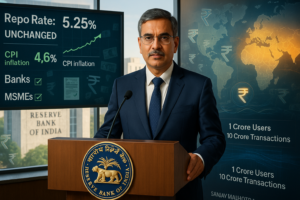
The Reserve Bank of India Monetary Policy Committee kept the benchmark repo rate unchanged at 5.25% during its April 2026 policy review, maintaining a neutral stance as geopolitical tensions in the Middle East create uncertainty around inflation and growth projections. RBI Governor Sanjay Malhotra announced the unanimous decision following the three-day MPC meeting from April 6-8, 2026, with the central bank projecting FY27 GDP growth at 6.9% and CPI inflation at 4.6%.
Table of Contents
RBI Monetary Policy Decision: Status Quo Amid Global Volatility
The Reserve Bank of India maintained all key policy rates unchanged, with the repo rate at 5.25%, standing deposit facility rate at 5.00%, marginal standing facility rate at 5.50%, and bank rate at 5.50%. The cash reserve ratio remains at 3%. The RBI Monetary Policy Committee decision comes against the backdrop of heightened global geopolitical tensions due to the ongoing US-Iran conflict in the Middle East, which has triggered volatility in crude oil prices and currency markets.
Growth and Inflation Projections Reflect Geopolitical Risks
The Reserve Bank of India projected FY27 GDP growth at 6.9%, with quarterly estimates showing downward revisions for the first half of the fiscal year. Q1FY27 growth was cut to 6.8% from 6.9%, while Q2FY27 was reduced to 6.7% from 7%. The central bank maintained Q3FY27 at 7% and Q4FY27 at 7.2%. CPI inflation for FY27 was projected at 4.6%, with quarterly estimates showing Q1FY27 at 4.0%, Q2FY27 raised to 4.4% from 4.2%, Q3FY27 at 5.2%, and Q4FY27 at 4.7%.
Key Policy Announcements and Regulatory Measures
The Reserve Bank of India announced several regulatory measures aimed at promoting ease of doing business and enhancing market participation:
Investment Fluctuation Reserve Requirement Removed: The RBI proposed to dispense with the requirement for banks to maintain an investment fluctuation reserve as an additional buffer against depreciation in investment values.
Term Money Market Expansion: Non-bank participants including All India Financial Institutions, NBFCs, housing finance companies, and other companies will now be allowed to participate in the term money market segment to enhance depth and liquidity.
MSME Onboarding Simplified: The RBI will dispense with due diligence requirements for MSMEs while onboarding on Trade Receivables Discounting System platforms to encourage greater participation.
Capital Adequacy Computation Eased: Guidelines for inclusion of quarterly profits in capital to risk-weighted assets ratio computation for commercial banks will be altered to provide flexibility.
Forex Market Measures Temporary, Says RBI Governor
RBI Governor Sanjay Malhotra clarified that recent foreign exchange market measures, including curbs on position limits of lenders and restrictions on non-deliverable forwards, are temporary reactions to specific market movements and not structural changes. “These are not measures which are going to remain there forever,” Malhotra stated during the post-policy press conference, emphasizing the central bank’s long-term commitment to developing, broadening, and deepening forex markets.
Geopolitical Context: US-Iran Ceasefire and Energy Price Impact
The RBI Monetary Policy Committee meeting occurred as the United States and Iran agreed to a two-week ceasefire deal expected to halt American-Israeli attacks in exchange for Tehran reopening the Strait of Hormuz. Governor Malhotra described the ceasefire announcement as “pleasant news, but not something surprising,” received at 5:30 AM on policy day. The central bank’s baseline assumption for crude oil prices stands at $85 per barrel for FY27 and $75 per barrel for FY28.
Digital Currency Progress and Financial Inclusion
RBI Deputy Governor T Rabi Shankar highlighted significant progress in India’s central bank digital currency initiative, stating “CBDC is an innovation whose time has come.” The digital rupee now has approximately 1 crore users with total transactions around 10 crore, with the RBI focusing on developing programmability features and expanding use cases for the future of payments.
Market Reaction and Economic Outlook
Indian financial markets responded positively to the RBI policy announcement, with the Sensex jumping 2,659.11 points (3.56%) to 77,275.69 and the Nifty 50 gaining 785.05 points (3.40%) to 23,908.70. The Bank Nifty index surged 2,635.10 points (5.00%) to 55,351.35. RBI Deputy Governor Poonam Gupta noted that India’s relative attractiveness as an investment destination is increasing due to more attractive valuations, favorable exchange rates, and higher nominal GDP growth supporting earnings potential.
RBI’s Forward Guidance and Risk Assessment
The Reserve Bank of India Monetary Policy Committee emphasized that monetary policy is not a pre-set course of action, with future decisions dependent on evolving growth-inflation dynamics. Governor Malhotra stated, “It is possible that we continue to have low repo rates in short to medium term,” while acknowledging that further escalation of Middle East conflict, its geographical spread, and damage to energy infrastructure pose downside risks to domestic growth outlook. The RBI will continue proactive and pre-emptive liquidity management with system liquidity currently at an average daily surplus of ₹2.3 lakh crore.


Recent Comments