



Table of Contents
Major Forex Broker Exits UK Regulatory Regime Amid Strategic Shift
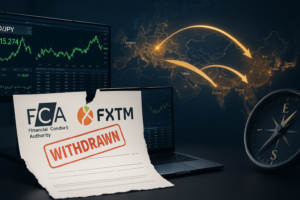
FXTM, the prominent forex and contracts for difference (CFD) broker owned by Russian-born billionaire Andrey Dashin, has decided to surrender its Financial Conduct Authority (FCA) license in the United Kingdom. The strategic move represents a significant shift in the global brokerage landscape as FXTM reallocates resources toward Asian and Middle Eastern markets where regulatory frameworks offer greater flexibility and growth potential.
The decision to abandon the FCA license follows years of increasing regulatory scrutiny and compliance costs in the United Kingdom. FXTM’s exit from the UK market underscores the growing tension between stringent European financial regulations and the competitive demands of global brokerage operations. The broker will now operate exclusively under its Cyprus Securities and Exchange Commission (CySEC) license and other international regulatory approvals.
Strategic Reorientation Toward High-Growth Regions
FXTM’s strategic pivot focuses resources on markets demonstrating explosive growth in retail trading participation. The Asian-Pacific region, particularly Southeast Asia, has witnessed unprecedented expansion in forex and CFD trading volumes throughout 2025 and early 2026. Similarly, Middle Eastern markets, especially the United Arab Emirates and Saudi Arabia, have emerged as critical growth corridors for international brokers seeking regulatory environments conducive to innovation.
The United Kingdom’s FCA has implemented progressively stricter rules governing leverage limits, marketing practices, and client protection measures since 2018. These regulations, while enhancing consumer protection, have substantially increased operational costs for brokers serving retail clients. FXTM’s calculated withdrawal from the UK market reflects a broader industry trend where compliance burdens influence geographic market prioritization.
Regulatory Landscape Analysis
The Financial Conduct Authority maintains one of the world’s most rigorous regulatory frameworks for retail trading providers. Key restrictions include:
- Maximum leverage limits of 30:1 for major currency pairs
- Negative balance protection requirements preventing client losses exceeding deposited funds
- Marketing restrictions on high-risk investment products
- Enhanced suitability assessments for retail clients
- Transparency requirements for pricing and execution quality
By contrast, regulatory authorities in emerging markets often permit higher leverage ratios and maintain less restrictive marketing frameworks. This regulatory asymmetry creates competitive advantages for brokers operating in jurisdictions with more permissive regimes, though consumer protection standards may vary significantly.
Market Implications and Competitive Dynamics
FXTM’s departure from the UK market creates strategic opportunities for remaining FCA-licensed brokers to capture market share. Competitors including IG Group, CMC Markets, and Plus500 may benefit from reduced competition in the UK retail trading segment. However, the exit also signals potential challenges for the FCA’s regulatory model if additional international brokers follow similar strategic paths.
The United Kingdom’s position as a global financial hub faces mounting pressure from regulatory arbitrage opportunities in alternative jurisdictions. Dubai’s Virtual Assets Regulatory Authority (VARA) and Abu Dhabi Global Market (ADGM) have actively courted international financial firms with streamlined licensing processes and innovation-friendly regulatory approaches. Similarly, Asian financial centers including Singapore and Hong Kong continue refining regulatory frameworks to attract international brokerage operations.
Client Transition and Operational Continuity
FXTM has initiated communication with UK-based clients regarding account transition procedures. The broker will facilitate seamless transfer of client positions and funds to its CySEC-regulated entity, ensuring uninterrupted trading access. Existing UK clients retain all contractual protections under European Union financial services regulations, which continue applying to CySEC-licensed entities through equivalence arrangements.
The operational transition involves significant technological and compliance infrastructure adjustments. FXTM must reconfigure payment processing, client onboarding, and reporting systems to align with CySEC requirements while maintaining service quality standards. The broker’s established presence in Cyprus provides foundational infrastructure supporting this regulatory migration.
Industry Trend Analysis
FXTM’s strategic reorientation reflects broader patterns in global brokerage mobility:
- Regulatory optimization: Brokers increasingly select jurisdictions balancing consumer protection with business flexibility
- Growth market prioritization: Emerging markets with expanding middle classes receive disproportionate resource allocation
- Digital transformation: Technology enables seamless cross-border client servicing despite regulatory fragmentation
- Specialization strategies: Brokers focus on specific client segments or product categories across optimal jurisdictions
The United Kingdom’s departure from the European Union has complicated regulatory coordination, though equivalence arrangements maintain market access for appropriately licensed firms. FXTM’s CySEC license preserves European Economic Area market access while reducing UK-specific compliance burdens.
Future Outlook and Strategic Considerations
FXTM’s license surrender represents a calculated strategic decision rather than regulatory enforcement action. The broker maintains clean compliance records with both FCA and CySEC authorities, with no public disciplinary actions affecting its UK operations. This distinguishes FXTM’s voluntary exit from license revocations resulting from regulatory violations.
The United Kingdom’s Financial Conduct Authority faces mounting pressure to balance consumer protection objectives with international competitiveness concerns. As global brokerage operations demonstrate increasing mobility across regulatory jurisdictions, UK authorities must evaluate whether current regulatory frameworks achieve optimal equilibrium between market integrity and industry sustainability.
FXTM’s strategic reallocation toward Asian and Middle Eastern markets anticipates continued growth in retail trading participation across these regions. Demographic trends, technological adoption rates, and financial inclusion initiatives collectively drive expansion in these markets, creating compelling opportunities for internationally experienced brokerage firms.
Conclusion: Regulatory Arbitrage Reshapes Global Brokerage Landscape
FXTM’s abandonment of its FCA license exemplifies how regulatory arbitrage influences global brokerage strategy in an increasingly interconnected financial ecosystem. The decision reflects sophisticated analysis of regulatory cost-benefit ratios across jurisdictions, combined with strategic prioritization of high-growth markets demonstrating favorable regulatory environments.
The United Kingdom’s Financial Conduct Authority maintains world-leading consumer protection standards, though these standards entail compliance costs influencing business location decisions. As international brokers optimize regulatory footprints across jurisdictions, global financial centers compete to establish regulatory frameworks balancing market integrity with industry competitiveness.
FXTM’s strategic pivot toward Asian and Middle Eastern markets signals confidence in these regions’ growth trajectories and regulatory environments. The broker’s continued operation under CySEC oversight preserves European market access while reallocating resources toward markets demonstrating superior growth potential and regulatory efficiency.


Recent Comments