



Last updated: November 23, 2026
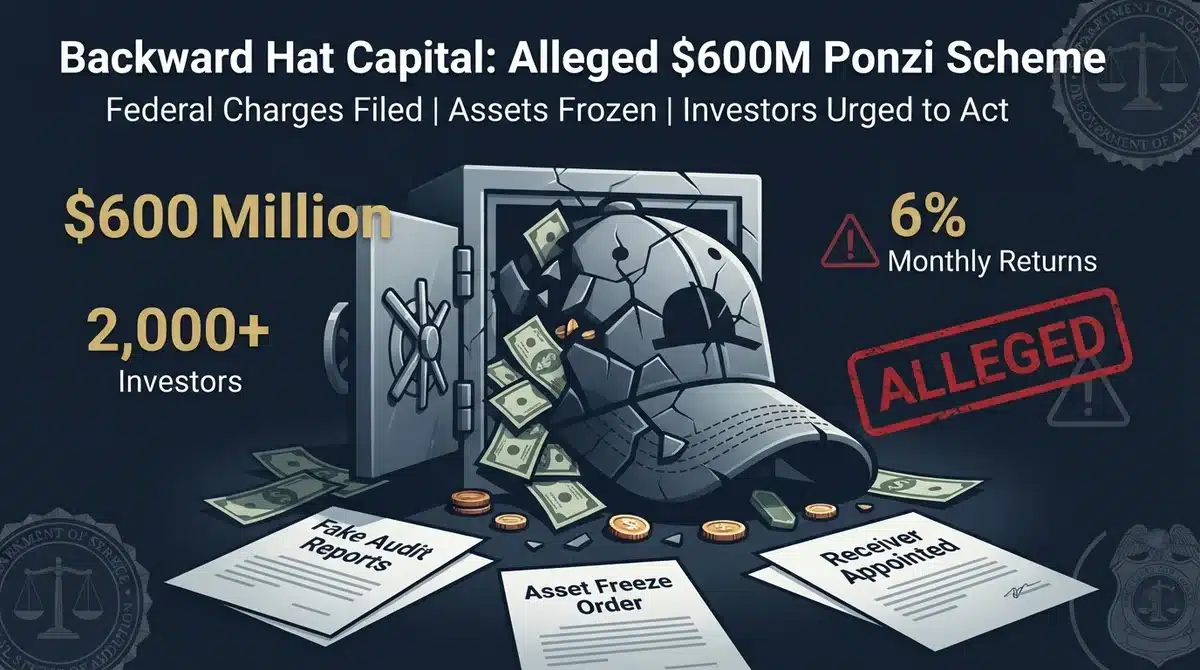
Federal regulators and prosecutors have charged the founders of Backward Hat Capital, an Indianapolis-based group of private funds, with running what they allege was a Ponzi scheme that took in roughly $550 million to $600 million from more than 2,000 investors. Co-founders Phillip Williams and Devin Johnson were arrested on November 18, 2026. A court has frozen assets and appointed a temporary receiver.
If you invested in a Backward Hat fund, or in the related AI Capital or Traders Point Capital funds, the next few weeks matter. This guide sets out what each agency has said, what has already happened to the money, and the practical steps investors can take now. All of the claims below are allegations; none has been proven in court.
Table of Contents
What the agencies say happened
Three federal actions were announced between November 18 and November 20. They describe the same scheme with slightly different totals, which is normal when agencies count different funds and periods.
| Agency | Action | Amount alleged | Investors |
|---|---|---|---|
| U.S. Attorney, Southern District of New York (with IRS-CI, HSI, FBI) | Criminal complaint: securities fraud and wire fraud against Williams and Johnson; both arrested November 18 | Over $600 million raised | More than 2,000 |
| SEC | Civil complaint in the Southern District of Indiana; temporary restraining order and asset freeze | About $560 million raised; more than $220 million taken by the founders | More than 2,000 |
| CFTC | Civil complaint against Williams, Johnson and 11 Backward Hat entities; asset freeze and temporary receiver | More than $550 million received | At least 2,100 |
According to the SEC, investors were told their money would be converted to crypto assets and used for foreign exchange (forex) arbitrage by a proprietary “AI-driven” algorithm that returned at least 6% a month. The SEC alleges the founders instead made more than $250 million in Ponzi-like payments to earlier investors and spent investor money on cars, homes and other businesses.
The SEC also charged Joseph Anderson, who it says produced fake “audit reports” and a “quality of earnings” report that claimed to confirm the funds’ returns. The CFTC says the funds reported returns above 6% a month “without a single losing month,” and that solicitation continued until at least October 2026.
Which funds are involved?
The CFTC complaint names these entities, which it says operated together as the “Backward Hat Common Enterprise”:
- Backward Hat Capital Fund LP
- BH Capital Fund I LP, III LP, IV LP, VI LP, IX LP, IX – 2 LP and X LP
- BHC V LLC
- Backward Hat Group LLC
- Backward Hat Capital Management LLC
The SEC adds Traders Point Capital, Devin Johnson’s Indianapolis company, and says Johnson raised money for a similar series of funds under the names AI Capital and Traders Point Capital.
I invested in Backward Hat Capital: what should I do now?
1. Fill out the FBI investor form
The FBI’s Indianapolis Field Office has opened a form for Backward Hat investors. The FBI says it is legally required to identify victims of the federal crimes it investigates, and that victims may be eligible for services, restitution and rights under federal or state law. Filling it out is voluntary. If you know someone else who invested, the FBI asks that they complete the form themselves.
2. Keep every record
Save account statements, the “audit” or earnings reports you were sent, emails and texts with anyone who sold you the investment, wire confirmations and tax forms. Receivers and prosecutors work from these records when they trace money and decide who is owed what.
3. Watch for the receiver’s notices
On November 20 the court appointed Kevin B. Duff as temporary receiver. According to the CFTC, he will take control of the company defendants, certain relief defendants and the individual defendants’ assets. In schemes like this, the receiver usually becomes the main point of contact for investors about any future claims process. No claims process has been announced yet.
4. Don’t pay anyone who promises to get your money back
Fraud victims are often targeted a second time by “recovery” services that charge upfront fees. Official contact will come from the FBI, the court-appointed receiver or the agencies above, not from someone who cold-calls you.
5. Get tax advice before you file
Many investors received “returns” that were reported to them and may have been taxed. Losses from investment fraud can have special tax treatment, so speak to a tax professional before you file your 2026 return.
Should “6% a month” have been a warning sign?
Yes, according to every agency involved. A steady 6% a month compounds to about 101% a year, meaning money would roughly double every twelve months. Federal prosecutors note the funds reported returns that “typically exceeded 6% per month.”
Several features in the agencies’ accounts match the classic signs of a Ponzi scheme:
- high, smooth returns with no losing months
- a secret “AI” or algorithmic strategy nobody can check
- a network of promoters paid to bring in new money
- “independent” audits that were, the SEC alleges, not independent
The SEC’s Investor.gov site lets you check whether someone selling you an investment is registered. The SEC says investors should use it before handing over money.
What happens next?
Williams and Johnson face criminal charges in New York, and parallel civil cases from the SEC and CFTC in Indiana. Those civil cases seek bans, disgorgement of ill-gotten gains, penalties and, in the CFTC case, restitution. The asset freeze is meant to stop more money leaving while the cases continue.
Recovery for investors depends on how much the receiver can trace and claw back, which in Ponzi cases can take years.
Related reading on TFM
- How regulators froze two firms’ activities in the UK: West 28th Street and Ethica Resolve
- Acorn Property Invest review: a regulator warning explained
- Bitrue review: what a regulator warning means for users
FAQ
Is Backward Hat Capital a Ponzi scheme?
The SEC, CFTC and federal prosecutors allege it operated as one. The charges have not been proven in court.
How much money is involved?
The agencies give figures between about $550 million and over $600 million, raised from more than 2,000 investors.
Who is the Backward Hat receiver?
Kevin B. Duff was appointed temporary receiver on November 20, 2026, according to the CFTC.
How do I report that I invested?
Use the FBI Indianapolis Field Office’s online form for Backward Hat investors.
Sources: SEC press release 2026-116 (November 20, 2026); CFTC press release 9328-26 (November 20, 2026); IRS-CI / U.S. Attorney SDNY announcement (November 18, 2026); FBI investor information form.
This article reports allegations made by federal agencies. The defendants are presumed innocent unless proven guilty. It is general information, not legal, tax or investment advice.


Recent Comments