



Last updated: 23 November 2026
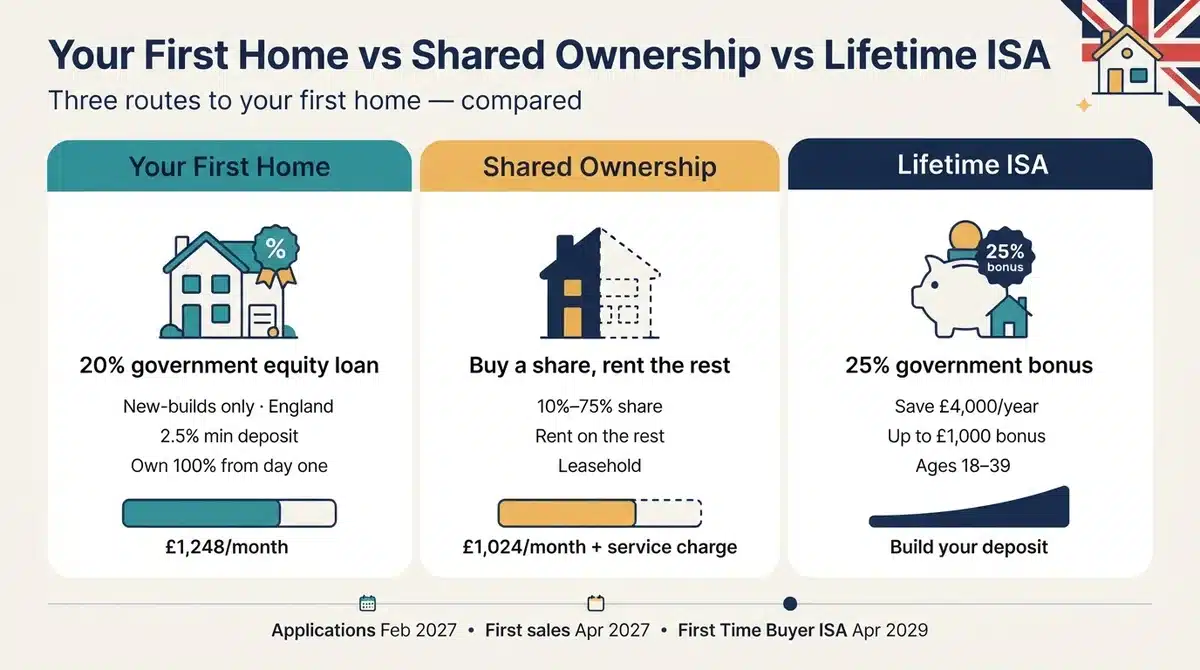
First-time buyers in England now have three very different kinds of help on the table. Your First Home is a new government equity loan for new-build homes, opening to applications in February 2027. Shared Ownership lets you buy part of a home and rent the rest. The Lifetime ISA, to be followed by the First Time Buyer ISA from April 2029, is a savings account with a government bonus.
They are often mentioned in the same breath, but they solve different problems. Two of them lower what you borrow. One helps you build the deposit. This guide compares them on the numbers that decide which one fits: income limits, deposit, monthly cost and what you owe when you sell.
Table of Contents
Contents
- The three schemes at a glance
- What each costs on a £300,000 home
- Your First Home: how the equity loan works
- Shared Ownership: rent on the part you don’t own
- Where the Lifetime ISA and First Time Buyer ISA fit
- Which scheme suits me?
- Key dates
- FAQ
The three schemes at a glance
| Your First Home | Shared Ownership | Lifetime ISA (First Time Buyer ISA from 2029) | |
|---|---|---|---|
| What it is | 20% government equity loan | Buy a share, pay rent on the rest | Savings account with a 25% bonus |
| Where | England, new-builds only | England (different rules in Scotland, Wales, NI) | UK |
| Household income limit | £110,000 (£140,000 in London) | £80,000 (£90,000 in London) | None |
| Minimum deposit | 2.5% of the price | Usually 5% to 10% of the share you buy | Not a mortgage product |
| Price limit | Local cap, e.g. £220,000 (County Durham) to £650,000 (inner London) | None set nationally | £450,000 |
| Ongoing extra cost | Loan interest from year 6 (1.5%, then 3%) | Rent, up to 3% a year of the landlord’s share (most charge 2.75%) | None |
| You own | 100% of the home from day one | Your share (10% to 75%); all shared ownership homes are leasehold | Whatever you buy with it |
| Available | Applications from February 2027 | Now | Lifetime ISA now (ages 18 to 39); First Time Buyer ISA from April 2029 |
Sources: GOV.UK Your First Home guidance (updated 3 November 2026), GOV.UK shared ownership guide, and our First Time Buyer ISA guide.
What each costs on a £300,000 home
Here is the same £300,000 new-build under each route. Mortgage figures assume a 30-year repayment mortgage at 5%, the rate used in the government’s own example. They are illustrations, not quotes, and exclude fees, insurance, council tax and service charges.
| Standard 95% mortgage | Your First Home | Shared Ownership, 40% share | |
|---|---|---|---|
| Deposit | £15,000 | £7,500 | £6,000 (5% of £120,000) |
| Mortgage | £285,000 | £232,500 | £114,000 |
| Government loan | None | £60,000 | None |
| Mortgage payment a month | £1,530 | £1,248 | £612 |
| Other monthly cost, years 1 to 5 | None | None | £413 rent (2.75% of £180,000 a year) |
| Total a month, years 1 to 5 | £1,530 | £1,248 | £1,024 plus service charge |
| Total a month from year 7 | £1,530 | £1,398 | Rent rises each year with inflation |
Shared Ownership has the lowest starting cost on paper. But you own 40% of the home, the rent goes up every year and never down, and there are usually service charges on top. Your First Home costs more each month but you own the whole home and the government shares in both rises and falls in its value.
Your First Home: how the equity loan works
You put down at least 2.5%, take a repayment mortgage from a participating lender, and the government lends you 20% of the price. The government is not a joint owner or your landlord. GOV.UK says £4.7 billion is set aside over five years.
The interest on the loan
| Period | Interest rate | On a £60,000 loan, a month |
|---|---|---|
| Years 1 to 5 | 0% | £0 |
| Year 6 | 1.5% | £75 |
| From year 7 | 3% | £150 |
The interest does not reduce what you owe. It is a separate cost.
What happens when I sell?
You repay 20% of the home’s value at the time, not the £60,000 you borrowed. If a £300,000 home is later valued at £320,000, you repay £64,000. If it falls to £280,000, you repay £56,000. You can repay some or all of it earlier. Full rules on valuations, minimum repayments and fees are still to be published.
Is my area’s price cap high enough?
Each council area has its own cap. A few examples from the published list:
| Area | Price cap |
|---|---|
| County Durham | £220,000 |
| Liverpool | £235,000 |
| Birmingham | £315,000 |
| Manchester | £355,000 |
| Brighton and Hove | £415,000 |
| Outer London boroughs (e.g. Croydon, Barnet) | £500,000 |
| Inner London boroughs (e.g. Hackney, Lambeth) | £650,000 |
Shared Ownership: rent on the part you don’t own
You buy between 10% and 75% of the home’s full market value and pay rent to the landlord, usually a housing association, on the rest. On new-build homes the rent is capped at 3% of the landlord’s share a year; GOV.UK says most landlords charge 2.75%.
Three things catch buyers out:
- Rent only goes one way. It is reviewed, usually yearly, and can rise but not fall. For leases signed on or after 12 October 2023 the cap is either RPI plus up to 0.5% or CPI plus 1%, depending on your lease.
- It is always leasehold. Expect service charges, and possibly estate charges, a management fee and payments into a reserve fund.
Shared Ownership is not only for first-time buyers. It is also open to former owners who cannot afford to buy now, people forming a new household and existing shared owners who need to move.
Where the Lifetime ISA and First Time Buyer ISA fit
The ISAs do something different: they help you build the deposit. Today’s Lifetime ISA is open to 18 to 39-year-olds, takes up to £4,000 a year and adds a 25% bonus, up to £1,000 a year, for a first home costing £450,000 or less. Save £4,000 a year for two years and the bonus is £2,000.
From April 2029 the First Time Buyer ISA replaces it for new savers, with no upper age limit and no withdrawal penalty. We cover the details in our First Time Buyer ISA guide.
Can I use a Lifetime ISA with Your First Home?
The government has not said yet. The Your First Home guidance published so far does not mention ISAs, and full eligibility rules are due before applications open in February 2027. If you plan to use a Lifetime ISA with either scheme, check the rules with your conveyancer early.
One practical point for Your First Home: its 2.5% minimum deposit on a £300,000 home is £7,500. A saver who puts £4,000 a year into a Lifetime ISA for two years would have £10,000 including the bonus, before interest, which is more than that minimum.
Which scheme suits me?
| If you… | Look first at | Why |
|---|---|---|
| Want a new-build, earn under £110,000 (£140,000 in London) and can afford a full repayment mortgage on 77.5% of the price | Your First Home | Smallest deposit, you own the whole home, no interest for five years |
| Earn under £80,000 (£90,000 in London) and cannot borrow enough for a whole home | Shared Ownership | Lowest borrowing; available now, including some resale homes |
| Are aged 18 to 39 and buying in a year or more | Lifetime ISA, alongside either scheme if the rules allow | 25% bonus on what you save |
| Are 40 or over, saving for a first home | A cash ISA now; the First Time Buyer ISA from April 2029 | The Lifetime ISA closes to new savers at 40 |
| Want an older (non-new-build) home | Shared Ownership resale or a standard mortgage | Your First Home covers new-builds only |
Whichever route you take, lenders still check affordability and credit history. If rates rise again, our tracker mortgage guide shows how quickly a payment can change. GOV.UK suggests getting independent financial and legal advice before you commit, and our guide on paying less mortgage interest covers the costs that build up over a long mortgage.
Key dates
| When | What |
|---|---|
| By the end of December 2026 | Your First Home: customer pre-registration and guidance; first developer registrations |
| February 2027 | Your First Home: first customer applications |
| April 2027 | Your First Home: first property sales |
| April 2029 | First Time Buyer ISA launches in place of the Lifetime ISA for new savers |
Pre-registration does not commit you to buying through the scheme, the government says, but it will tell you whether you are eligible and the price cap in your area.
FAQ
Is Your First Home the same as Help to Buy?
It works in a similar way, with a government equity loan on a new-build. The terms differ: a 2.5% minimum deposit, a 20% loan, household income caps of £110,000 or £140,000 in London, and local price caps.
Who can apply for Shared Ownership?
Households earning £80,000 or less (£90,000 in London) who cannot afford a suitable home outright. You must also be a first-time buyer, a former owner who cannot afford to buy now, forming a new household, an existing shared owner who wants to move, or an owner who cannot afford a suitable new home.
When can I apply for Your First Home?
Pre-registration is due by the end of December 2026 and applications from February 2027, with first sales expected in April 2027.
Which is cheaper each month, Your First Home or Shared Ownership?
On a £300,000 home with a 40% share, Shared Ownership starts lower (about £1,024 a month plus service charges, against £1,248). But shared owners pay rising rent and own only part of the home.
Sources: MHCLG, Your First Home guidance (28 October 2026, updated 3 November 2026); Your First Home local authority price caps; GOV.UK shared ownership guide; GOV.UK Lifetime ISA; HM Treasury First Time Buyer ISA consultation and response.
This article is general information, not financial or mortgage advice.


Recent Comments