



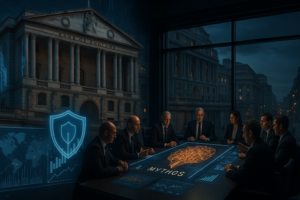
The Bank of England has initiated emergency meetings with major UK financial institutions to address cybersecurity vulnerabilities identified in Anthropic PBC’s newly launched artificial intelligence model “Mythos”. British regulators join a growing global coalition of central banks and financial authorities expressing urgent concerns about AI-enabled cyber threats targeting critical banking infrastructure.
Table of Contents
Global Regulatory Coordination
The Bank of England’s emergency sessions follow similar urgent meetings convened by the United States Federal Reserve, Treasury Department, and Bank of Canada. This coordinated international response represents what financial stability experts describe as “unprecedented regulatory alignment” on emerging AI threats to the global financial system.
The Cross-Market Operations Resilience Group and CMORG AI Task Force have scheduled meetings over the next two weeks with representatives from systemic UK banks, payment processors, and financial market infrastructure providers. The discussions will focus on specific threat vectors identified in preliminary assessments of the Anthropic “Mythos” model’s capabilities.
Specific Threat Vectors Identified
Regulatory briefings obtained by The Fintech Mag outline three primary concern areas driving the emergency response:
1. AI-Generated Social Engineering: The “Mythos” model demonstrates advanced capabilities in generating highly convincing phishing communications, synthetic voice impersonations, and targeted social engineering campaigns that could bypass traditional employee training and technical controls.
2. Automated Vulnerability Discovery: Early testing indicates the AI model can rapidly identify and exploit software vulnerabilities in banking systems, potentially accelerating cyberattack timelines from months to hours.
3. Real-Time Attack Adaptation: The model’s ability to analyze defensive responses and adapt attack strategies in real-time presents what cybersecurity experts term a “paradigm shift” in threat sophistication.
Banking Sector Preparedness Assessment
The Bank of England meetings will include detailed assessments of UK financial institutions’ current cybersecurity postures and their capacity to defend against AI-enhanced threats. Key evaluation areas include:
Technical Defenses: Current endpoint protection, network monitoring, and intrusion detection systems’ effectiveness against AI-generated attack patterns.
Employee Training: Staff preparedness for identifying and responding to sophisticated AI-generated social engineering attempts.
Incident Response: Emergency protocols for containing and mitigating AI-driven cyber incidents that may propagate more rapidly than traditional attacks.
Third-Party Risk: Vulnerability assessments for critical service providers and technology vendors within banking supply chains.
International Regulatory Implications
The coordinated response from UK, US, and Canadian regulators establishes important precedents for international financial cybersecurity cooperation. Industry analysts predict the emergency meetings will lead to:
Enhanced Standards: New regulatory requirements for AI threat detection and response capabilities at systemically important financial institutions.
Information Sharing: Expanded cross-border intelligence exchange on emerging AI threats and defensive best practices.
Testing Frameworks: Development of standardized stress testing scenarios incorporating AI-enhanced cyberattack simulations.
Vendor Oversight: Increased regulatory scrutiny of AI technology providers serving the financial sector.
Forward Outlook and Industry Response
UK banking executives have welcomed the Bank of England’s proactive engagement while acknowledging the significant challenges presented by advanced AI threats. Major financial institutions are reportedly accelerating investments in AI defense technologies and specialized cybersecurity talent recruitment.
The emergency meetings represent what financial stability experts describe as a “watershed moment” in regulatory recognition of AI’s dual-use nature within financial services. While artificial intelligence offers transformative potential for fraud detection, risk management, and customer service, the Anthropic “Mythos” model revelations highlight equally transformative risks that demand immediate regulatory attention.
The Bank of England has indicated it will issue formal guidance following the emergency meetings, potentially establishing new cybersecurity standards for UK financial institutions facing what regulators now identify as the “most significant emerging risk” to financial system stability.


Recent Comments