




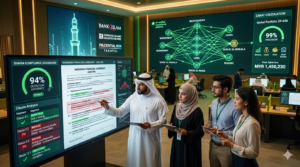
The principles underlying Sharia-compliant screening systems parallel broader innovations in AI in asset management, where algorithmic oversight enhances both compliance and portfolio analysis across diverse regulatory frameworks.
Table of Contents
The Islamic Finance Landscape: Why AI Is Essential
Islamic finance has grown to $4.5 trillion in assets globally, spanning banking, capital markets, and insurance (takaful). Its core principles—prohibition of riba (interest), gharar (excessive uncertainty), and investment in haram (forbidden) activities—demand rigorous oversight. A single transaction may involve 50+ pages of legal documentation, multiple Sharia scholars, and weeks of manual review. Compliance costs can exceed 20% of operating expenses, and the complexity of modern financial structures makes manual auditing increasingly error‑prone. AI offers a path to scale Sharia compliance while preserving the principles that define Islamic finance.
Four Breakthrough Applications in Production
Leading Islamic financial institutions have deployed AI across the compliance and operational lifecycle. Below are four deployments demonstrating measurable ROI.
1. Bank Islam Malaysia: 70% Reduction in Sharia Audit Time
Bank Islam Malaysia, the country’s oldest Islamic bank, processes over 2,000 new financing contracts monthly. Its AI‑powered Sharia audit platform uses natural language processing to scan contracts for prohibited clauses: interest calculations, speculative structures, and impermissible asset classes.
- Technology: A custom NLP model trained on 50,000+ historical contracts annotated by Sharia scholars; it flags non‑compliant clauses and suggests alternatives based on Sharia board precedents.
- Results: Audit time reduced from 3 days to 6 hours (70% reduction); Sharia scholar workload shifted from routine review to complex fatwa issuance.
- Accuracy: 94% agreement with human scholars on compliance classification; false positives under 2%.
“Our Sharia scholars now focus on innovation, not paperwork. AI handles the routine, freeing them to address novel financial structures.”
2. Emirates Islamic: 94% Accuracy in Detecting Riba and Gharar
Emirates Islamic serves over 500,000 customers across retail, corporate, and wealth management. Its AI system scans contracts, investment portfolios, and trading algorithms for riba (interest) and gharar (excessive uncertainty).
- Detection techniques: NLP for contract clause analysis; machine learning to flag interest‑based returns in investment portfolios; anomaly detection for speculative trades.
- Performance metrics: 94% accuracy in identifying non‑Sharia elements; 60% reduction in false positives compared to rule‑based systems.
- Deployment: Integrated into the core banking system; alerts Sharia audit team within minutes of contract origination.
“Our AI doesn’t just flag problems—it provides alternative structures aligned with Sharia principles. This has accelerated product development.”
3. Saudi Digital Islamic Bank: 99% Precision in Zakat Optimization
Saudi Digital Islamic Bank (SDIB) offers automated zakat calculation for its 1.5 million customers. Zakat, the obligatory charitable contribution, is calculated on assets held for one lunar year. Complexity arises from mixed asset classes: cash, gold, stocks, real estate, and business inventory. SDIB’s AI system automates the calculation using real‑time portfolio data.
- Methodology: Rules‑based logic for asset classification, machine learning to estimate inventory valuation, and automated integration with customer accounts.
- Results: 99% precision in zakat amounts (validated by Sharia scholars); 78% of customers completed zakat calculation in under 5 minutes; total zakat paid via the platform exceeded $120 million in 2025.
- Additional benefit: The platform recommends zakat‑eligible charities based on customer preferences, increasing charitable distribution effectiveness.
“Zakat is a pillar of Islam, but many Muslims struggle to calculate it accurately. Our AI makes it simple, transparent, and aligned with classical fiqh.”
4. Prudential BSN Takaful: AI‑Powered Takaful Underwriting
Prudential BSN Takaful (PBT), a leading Islamic insurer in Malaysia, uses AI to underwrite family takaful policies. Traditional takaful underwriting relies on manual risk assessment, leading to processing times of 5–7 days. PBT’s AI system automates risk scoring using medical questionnaires, historical claims, and external data.
- AI model: Gradient‑boosted trees trained on 200,000+ past applications; predicts mortality and morbidity risk with 92% accuracy.
- Results: Underwriting time reduced from 5 days to 30 minutes; approval rate increased by 15% for low‑risk applicants; administrative costs cut by 40%.
- Sharia oversight: All AI decisions are reviewed by the Sharia committee to ensure compliance with tabarru’ (donation) and mutual risk‑sharing principles.
“AI allows us to offer affordable takaful to underserved segments while maintaining the cooperative spirit of Islamic insurance.”
Comparative Performance: AI vs. Traditional Islamic Finance Processes
The table below summarizes quantitative improvements from the case studies:
| Metric | Traditional Process | AI‑Powered Process | Improvement |
|---|---|---|---|
| Sharia audit time (per contract) | 3 days | 6 hours | 70% reduction |
| Riba/gharar detection accuracy | 78% (manual review) | 94% | +16 percentage points |
| Zakat calculation time | 1–2 hours (manual) | 5 minutes | 95% reduction |
| Takaful underwriting time | 5 days | 30 minutes | 90% reduction |
Technology Stack: How AI Powers Sharia Compliance
Islamic finance AI systems share common architectural components:
- Natural Language Processing (NLP): Analyzes contracts, fatwas, and legal texts to extract compliance‑relevant clauses.
- Machine Learning Classification: Categorizes transactions as halal/permissible or haram/forbidden based on training data from Sharia scholars.
- Graph Analytics: Maps ownership structures to identify complex holdings requiring zakat or revealing hidden riba exposure.
- Explainable AI (XAI): Provides reasoning for compliance decisions, enabling Sharia scholars to audit AI outputs.
- Integration APIs: Connects to core banking, investment, and insurance systems for real‑time monitoring.
Platforms like Dataiku, which emphasize governance and explainability, are increasingly used to develop and deploy these models while maintaining Sharia oversight.
Implementation Roadmap: From Pilot to Scale
Institutions that have successfully deployed AI in Islamic finance follow a phased approach:
Phase 1: Foundation (Months 1–6)
- ✔️ Digitize and annotate Sharia contracts and fatwas to create a training corpus.
- ✔️ Deploy NLP to classify contract clauses as compliant or non‑compliant.
- ✔️ Build a dashboard for Sharia audit teams to review AI flags.
Pro tip: Start with one product type—murabaha (cost‑plus) financing—which has standardized documentation.
Phase 2: Intelligence (Months 7–18)
- ✔️ Train models to detect subtle gharar (uncertainty) and riba across multiple contract types.
- ✔️ Integrate with investment portfolio systems to screen holdings automatically.
- ✔️ Automate zakat calculations for retail and institutional clients.
Real talk: This phase requires close collaboration between data scientists, Sharia scholars, and compliance officers.
Phase 3: Transformation (Months 19–36)
- ✔️ Deploy graph analytics to detect complex fraud and hidden interest exposure across subsidiaries.
- ✔️ Offer Sharia‑audited AI‑generated investment recommendations to clients.
- ✔️ Embed AI into takaful underwriting, claims, and pricing.
Remember: The end goal is end‑to‑end Sharia compliance that operates at the speed of digital finance.
Navigating the Challenges
AI adoption in Islamic finance faces unique hurdles. Below are common obstacles and proven countermeasures.
Interpretation Variance Across Jurisdictions
Issue: Sharia interpretations differ between Malaysia, GCC, and other regions.
Solution: Train separate models for each jurisdiction’s Sharia board rulings. Bank Islam Malaysia uses region‑specific NLP models that incorporate local fatwa databases.
Explainability and Scholar Trust
Issue: Sharia scholars require transparency in AI decisions.
Solution: Use explainable AI (SHAP, LIME) to provide reasoning. Emirates Islamic requires that every AI flag include a human‑readable justification linked to relevant fatwa text.
Data Scarcity for Training
Issue: Annotated Sharia‑compliant datasets are limited.
Solution: Use transfer learning from general Arabic/English legal models and active learning to maximize scholar input efficiency. Saudi Digital Islamic Bank built its zakat model using 10,000 manually annotated portfolios, achieving 99% precision.
Integration with Legacy Islamic Banking Systems
Issue: Many Islamic banks run on core systems not designed for real‑time AI.
Solution: Build middleware APIs that extract transaction data for AI analysis without disrupting core processing.
Reader Q&A: Real Islamic Finance Concerns
Q: “Can AI truly understand Sharia principles, or does it just pattern‑match?”
A: AI does not “understand” in the human sense. It pattern‑matches against precedents. However, when trained on fatwas and approved contracts, it can replicate scholars’ classification with high accuracy. Scholars remain the ultimate authority; AI is a tool to scale their oversight.
Q: “Does AI replace the role of Sharia scholars?”
A: No—it augments them. Routine contract screening and portfolio monitoring are automated, allowing scholars to focus on novel structures and complex fatwas. Bank Islam Malaysia reported scholars now spend 80% of time on innovation versus 20% on manual review.
Q: “Can small Islamic institutions afford AI?”
A: Yes, through cloud‑based Islamic fintech platforms like Finterra, Cur8, and Wahed. These offer pay‑per‑use Sharia screening, zakat calculation, and takaful underwriting APIs.
Free Checklist: 5 Signs Your Islamic Finance Institution Needs AI
- ☐ Sharia audit takes >48 hours per transaction
- ☐ You’ve been cited by regulators for inconsistent Sharia compliance
- ☐ Zakat calculation errors have led to customer complaints
- ☐ Takaful underwriting takes >3 days
- ☐ Your investment portfolio screening is manual and monthly, not real‑time
The Future: Where Islamic Finance AI Is Heading
As AI capabilities and Sharia acceptance grow, four frontiers are emerging:
- Generative AI for fatwa drafting: AI‑assisted research that synthesizes classical fiqh and modern financial structures to propose new fatwas.
- Autonomous waqf (endowment) management: AI that optimizes waqf assets for social impact while ensuring Sharia compliance.
- Cross‑border Sharia harmonization: AI models that reconcile differences between Malaysia’s Shafi’i school and GCC’s Hanbali school, enabling global Islamic products.
- Predictive takaful pricing: AI models that price takaful contributions based on individual risk while maintaining mutual surplus‑sharing principles.
“Islamic finance has always been about ethics and justice. AI can help us scale those principles to every corner of the global economy.”
Key Takeaways: The AI‑Powered Islamic Financial Institution
- Start with contract screening—it delivers immediate ROI and builds trust with Sharia scholars.
- Zakat automation is a customer‑facing differentiator—Saudi Digital Islamic Bank saw 30% new customer acquisition via its zakat tool.
- Explainability is non‑negotiable—Scholars must understand AI reasoning to sign off.
- Augment, don’t replace—AI frees scholars for higher‑value work; it does not replace human judgment.


Recent Comments