


In today’s fast-evolving fintech landscape, the Philippines has evolved into a DevOps-integrated support hub. By leveraging specialized “Technical Architects” who manage the complex interoperability between neobanks, APIs, and global banking rails, Philippine BPOs ensure that the technical “glue” of the digital economy remains resilient under the $2 trillion global transaction load.
Table of Contents
Strategic Intelligence Briefing
-
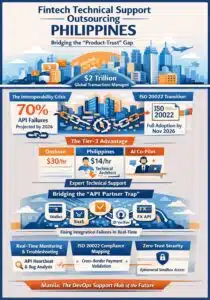
The Interoperability Crisis: 70% of fintech transaction failures in 2026 occur in the API layer between third-party partners. Philippine teams now function as real-time “Translation Layers” to resolve these integration bottlenecks.
-
ISO 20022 Compliance: As the global banking system fully transitions to ISO 20022 by November 2026, Manila-based hubs are managing the manual mapping of rich-data payment messages to prevent cross-border rejections.
-
The Tier-3 Pivot: Neobanks are bypassing $30/hr onshore engineers by deploying $14/hr Philippine “Technical Architects” who use Agentic AI co-pilots to perform deep log aggregation and bug pattern recognition.
-
Product-Trust Gap: In an era of “Composable Banking,” the line between a software bug and a financial loss has vanished. Manila teams bridge this gap by troubleshooting broken integrations in real-time.
The 2026 API “Partner Trap”: Why General Support Fails
The global fintech ecosystem has transitioned from standalone applications to a hyper-connected web of nodes. Today, a single digital wallet transaction often relies on a fragile chain of third-party integrations: a banking-as-a-service (BaaS) provider, a biometric ID verifier, and a niche API specialist for FX rates. This complexity has led to the “API Partner Trap”—where a failure in one node halts the entire user experience. When a transaction hangs in “limbo,” the user doesn’t care whose API failed; they care that their money is inaccessible.
To mitigate this, global fintech leaders have shifted their technical support to the Philippines. This move is no longer about call volume; it is about Technical Resilience. Specialized Manila hubs now house “Real-Time DevOps” extensions. These teams don’t just read support scripts; they monitor API heartbeats, flag partner latency, and perform initial pattern recognition of core system bugs. By partnering with the top 1% of the BPO market through an advisory like PITON-Global, fintechs are ensuring that their support tier acts as a sophisticated diagnostic layer that identifies and resolves integration friction before it triggers mass user churn.
Table 1: The 2026 Technical Support Functional Matrix
|
Support Tier |
Agentic AI Role (Automation) |
Human Value-Add (Manila) |
Strategic Impact |
|
Tier 1: Access |
85% Auto-resolution for MFA/Biometric sync |
Guiding high-value users through complex identity recovery |
Reduced Friction |
|
Tier 2: Ecosystem |
Monitoring API heartbeats & flagging latency |
Troubleshooting “broken integrations” between apps and BaaS partners |
Churn Prevention |
|
Tier 3: Core Systems |
Real-time log aggregation |
Pattern recognition of bugs & “Translation” for onshore engineering |
Engineering Efficiency |
Expert Deep Dive: The Technical Intermediary Model
Navigating the ISO 20022 “Rich Data” Deadline
The global financial system is completing its migration to the ISO 20022 standard. This transition introduces a massive technical hurdle: payments now carry significantly more data, and any “unstructured” information can trigger an automatic rejection. Philippine technical support hubs have become the primary Translation Layer for this shift. At a $14/hour fully loaded benchmark, these specialized teams manage the manual mapping of ISO-compliant messages and resolve rejections caused by legacy system data drift. This ensures that a fintech’s cross-border payments do not hang in “compliance limbo” during the global move toward native ISO processing.
Agentic AI: The Support Engineer’s “Co-Pilot”
The most transformative shift today is the integration of Agentic AI within the BPO workflow. Unlike basic chatbots, these are autonomous agents that assist the human specialist.
Expert Technical Insight: “The answer to the engineering talent crunch isn’t just hiring more devs; it’s empowering specialized BPO talent with AI co-pilots,” explains Ralf Ellspermann, CSO of PITON-Global. “Our BPO partners in Manila are hiring computer science graduates and giving them ‘superpowers’ via agentic AI. This allows a support specialist to function at a Tier-3 diagnostic level for a Tier-1 price. That is the essence of Intelligence Arbitrage in 2026.”
The “Continuous Close” & Atomic Reconciliation
FinOps (Financial Operations) has moved away from manual month-end scrambles to a “Continuous Close” model. In this environment, every transaction must be reconciled in sub-seconds. When discrepancies occur—often due to timing differences between a neobank’s ledger and a partner bank’s database—Philippine “Data Architects” step in. They perform Atomic Reconciliation, utilizing automated scripts to identify “drift” and manually correcting entries before they impact a platform’s real-time liquidity reporting.
Table 2: Financial Integrity & Movement Benchmarks
|
FinOps Process |
Legacy Outsourcing Model |
2026/27 Specialized Manila Model |
Accuracy Gain |
|
Dispute Triage |
3 – 5 Days |
< 120 Minutes (Real-Time) |
400% Improvement |
|
A/R Reconciliation |
Batch Processing (Weekly) |
Continuous (Atomic Close) |
99.9% Data Health |
|
Chargeback Defense |
Manual Documentation |
AI-Augmented Evidence Mapping |
35% Higher Win-Rate |
Zero-Trust Implementation: The “Ephemeral Sandbox”
For a fintech CTO, the primary risk of outsourcing technical support is system access. Granting a third-party agent the power to run SQL queries or view transaction logs is an existential security threat. Leading Philippine BPOs have neutralized this risk by implementing Zero-Trust Ephemeral Sandboxes.
In this model, a support specialist is granted a temporary, read-only “sandbox” of a customer’s technical data. This environment is surfaced via a secure Virtual Desktop Infrastructure (VDI) and expires the moment the ticket is closed. No raw data ever leaves the fintech’s domestic cloud environment (AWS/Azure), ensuring total data residency compliance while providing the Manila team with the granular visibility required to solve Tier-3 technical issues.
Expert Strategic Insight: “Today, the distinction between ‘in-house’ and ‘outsourced’ is dissolving into a model of borderless integration,” says John Maczynski, CEO of PITON-Global. “The successful fintechs are those that view their Philippine operations not as a peripheral cost-center, but as a core engine of their global technical strategy. A clean audit history and 99.9% uptime are now decisive factors for IPO valuations, and that starts in the Manila technical hub.”
Table 3: The 2026 Tech-Support Selection Matrix
|
Selection Factor |
Generalist BPO |
Specialized “Top 1%” Hub |
|
Talent Profile |
High-school / Generalist |
CS Grads / Technical Architects |
|
Infrastructure |
Standard VPN |
Zero-Trust Ephemeral Sandboxes |
|
Tooling |
Legacy CRM |
Dev-Ops Integrated (Jira/GitHub/Datadog) |
|
Compliance |
Basic PCI-DSS |
ISO 20022 & GDPR “Clean Room” Ready |
Expert FAQ: Technical Fintech Support
1. How do Manila teams handle “Rich Data” errors in cross-border payments? By using automated parsing tools to identify unstructured fields in ISO 20022 messages. The team then manually reconciles the data against the sender’s profile to ensure the payment meets the recipient bank’s “Structured Data” requirements.
2. Can these teams manage real-time “Dev-Ops” tasks? Yes. Specialized tiers in the Philippines now operate in “Shadow Engineering” modes—monitoring system health dashboards (like New Relic or Datadog) and performing initial triage on server-side errors before escalating to the core onshore engineering team.
3. What is the “Product-Trust” gap? It is the loss of user confidence that occurs when a technical glitch is treated as a generic customer service issue. By having “Technical Architects” who understand the why behind a failed API call, fintechs can provide high-resolution answers that rebuild user trust instantly.
4. Why is the $14/hour benchmark significant? It represents the “Sweet Spot” of intelligence arbitrage. At this rate, fintechs can afford high-IQ, technical talent in Manila that would cost 4x as much in the US or UK, allowing for a 24/7/365 Tier-3 technical support presence.
Final Thought: “As fintech products become increasingly modular, the support function must become increasingly technical. The Philippines provides the specialized talent and secure infrastructure to turn support from a cost-center into a competitive technical advantage.”



Recent Comments