

San Francisco Federal Reserve President Mary Daly has delivered a sobering assessment of the U.S. inflation outlook, warning that the oil shock resulting from the ongoing Iran war will significantly extend the timeline for returning inflation to the central bank’s 2% target. In an exclusive interview with Reuters on April 10, 2026, Daly acknowledged that while the U.S. economy remains fundamentally solid and monetary policy is appropriately restrictive, geopolitical factors have introduced new complications for price stability.
Table of Contents
Key Takeaways
- Extended Inflation Timeline: Oil shock from Iran conflict pushes back expected return to 2% inflation target
- Policy Stance Appropriate: Current restrictive monetary policy described as being in a “good place”
- Economic Fundamentals Solid: U.S. economy remains strong with steady labor market conditions
- Geopolitical Complications: Middle East conflict introduces new variables into inflation calculus
- No Immediate Policy Shift: Fed maintains current stance amid evolving economic landscape
The Geopolitical Inflation Challenge
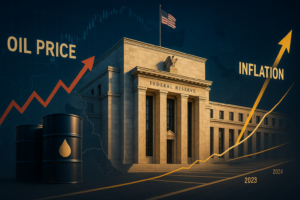
The Federal Reserve faces what Daly characterized as a “complicated inflation landscape” shaped by the convergence of domestic economic strength and international geopolitical instability. The San Francisco Fed president noted that the oil price surge following the escalation of conflict in the Middle East has created what economists term “imported inflation” – price pressures that originate outside national borders but impact domestic price levels through energy and transportation costs.
“The U.S. economy is fundamentally solid, the labor market has steadied, and monetary policy is in a ‘good place’ – restrictive enough to put downward pressure on inflation. However, the oil shock from the Iran war means getting inflation down to our 2% target will take longer than previously anticipated.”
Daly’s comments represent the most explicit acknowledgment yet from a senior Fed official that the timeline for inflation normalization has been extended by geopolitical developments. This assessment comes as the Federal Reserve maintains its federal funds rate target range of 3.5% to 3.75%, a level that Daly described as appropriately restrictive given current economic conditions.
Economic Context and Policy Implications
The Federal Reserve’s inflation challenge occurs against a backdrop of what Daly described as “fundamentally solid” economic conditions. The U.S. labor market has shown remarkable resilience, with unemployment remaining near historic lows and wage growth moderating to sustainable levels. This economic strength provides the Federal Reserve with what policymakers term “policy space” – the ability to maintain restrictive settings without triggering a recession.
However, the oil shock introduces what economists call a “supply-side inflation” component that is less responsive to traditional monetary policy tools. While interest rate increases can dampen demand-driven inflation by making borrowing more expensive and slowing economic activity, they have limited direct impact on price increases caused by supply disruptions or geopolitical events.
Monetary Policy Calculus
Daly’s assessment suggests the Federal Reserve is engaged in a delicate balancing act. On one side, maintaining restrictive policy settings risks overtightening and triggering an unnecessary economic slowdown. On the other, premature easing could allow inflationary expectations to become entrenched, making the eventual return to 2% inflation more difficult and costly.
The San Francisco Fed president emphasized that current policy settings represent what she termed a “good place” – sufficiently restrictive to continue applying downward pressure on inflation while avoiding excessive economic damage. This characterization aligns with the Federal Reserve’s recent communications, which have emphasized a data-dependent approach that avoids pre-committing to specific policy paths.
Broader Implications for Global Central Banking
Daly’s warning about extended inflation timelines reflects a broader pattern among global central banks grappling with the economic consequences of Middle East conflict. The Bank of England recently issued similar warnings about inflationary pressures, while the European Central Bank has acknowledged the complicating effects of energy price volatility on its policy decisions.
This coordinated concern among major central banks highlights what financial analysts describe as a “synchronized inflation challenge” – a rare instance where multiple major economies face similar price stability threats from common geopolitical sources. The situation represents a departure from the post-pandemic inflation episode, which featured more divergent patterns across different economies and regions.
Market Reactions and Forward Outlook
Financial markets have largely priced in the extended inflation timeline described by Daly, with interest rate futures now showing reduced expectations for Federal Reserve rate cuts in 2026. The yield curve has steepened slightly as investors adjust to the prospect of prolonged restrictive policy, while equity markets have shown resilience amid the recognition of underlying economic strength.
Looking forward, Daly indicated that the Federal Reserve will maintain its meeting-by-meeting approach to policy decisions, with particular attention to incoming data on inflation, employment, and economic growth. The central bank’s next policy meeting in May 2026 will provide further insight into how policymakers are weighing the competing considerations of economic strength against extended inflation timelines.



Recent Comments