



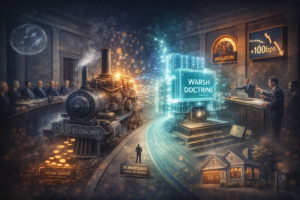
TL;DR: Kevin Warsh, the nominee for the next Federal Reserve Chair, is championing a revolutionary “AI-first” monetary policy. He argues that Artificial Intelligence is a massive productivity boom that acts as a structural disinflationary force, giving the Fed room to slash interest rates by as much as 100 basis points in 2026 without triggering a price spiral.
For decades, the Federal Reserve has operated on a simple, often painful logic: if you want to cool inflation, you must cool the economy. But as the transition from Jerome Powell to Kevin Warsh looms in May 2026, a new doctrine is emerging in Washington—one that replaces labor-market suppression with technology-driven growth.
Warsh’s core thesis is bold: we are entering a “New Economic Era” where AI silicon does the heavy lifting that human labor once did, allowing the U.S. economy to run hotter and faster while prices actually stay stable.
Table of Contents
The “Warsh Doctrine”: AI as a Disinflationary Engine
Traditional economists fear that low interest rates inevitably lead to “too much money chasing too few goods.” Warsh rejects this, drawing a direct parallel to the 1990s internet boom.
Under his view, AI is not just another tech trend; it is a fundamental shift in unit economics. If a company can use AI to produce twice as much output with the same energy and overhead, the cost of that output drops. When costs drop across the entire economy, inflation “cools from the inside.”
– Productivity Gains: AI allows for faster software development, automated logistics, and rapid drug discovery, all of which reduce the cost of doing business.
– Supply-Side Shock: Unlike stimulus checks (which boost demand), technology boosts supply. This allows the Fed to lower rates (making loans cheaper for humans) because the “supply” of goods and services is expanding even faster.
100 Basis Points: The 2026 Shock Forecast
Wall Street analysts are already repricing their expectations for the second half of 2026. While the “old” Fed was hesitant to cut rates while unemployment was low, the “Warsh Fed” is expected to be much more aggressive.
Economists now predict a potential 100 basis point cut within Warsh’s first six months in office. The goal? To cement American competitiveness by making capital cheap for the very firms building the AI infrastructure that is cooling inflation in the first place.
The Risks: Asset Bubbles vs. Real Growth
Not everyone is convinced. Critics argue that Warsh is “betting the farm” on a productivity miracle that hasn’t fully shown up in the official data yet.
– The “AI Bubble” Risk: Low rates could pump billions into speculative AI startups that don’t actually produce anything, leading to an 18th-century style “South Sea Bubble” in digital form.
– Data Lag: Traditional economic metrics (like the CPI) often take months or years to reflect technological shifts. Cutting rates too early based on “AI vibes” rather than hard data could still risk a 1970s-style inflation rebound.
What This Means for Humans
If the Warsh Doctrine holds true, the 2026 fintech landscape will be defined by cheap credit and high innovation.
For the average consumer, this could mean the return of 3% mortgage rates and affordable small business loans, even as the AI revolution continues to reshape the workforce. The “soft landing” that Jerome Powell chased for years might finally be achieved—not by managing interest rates, but by lean-starting the economy with artificial intelligence.
Sources:
Axios Capital
https://www.axios.com/2026/01/30/kevin-warsh-trump-fed-ai
Politico Economy
https://www.politico.com/news/magazine/2026/01/30/how-a-famed-economist-views-kevin-warsh-for-fed-chair-00758145


Recent Comments